
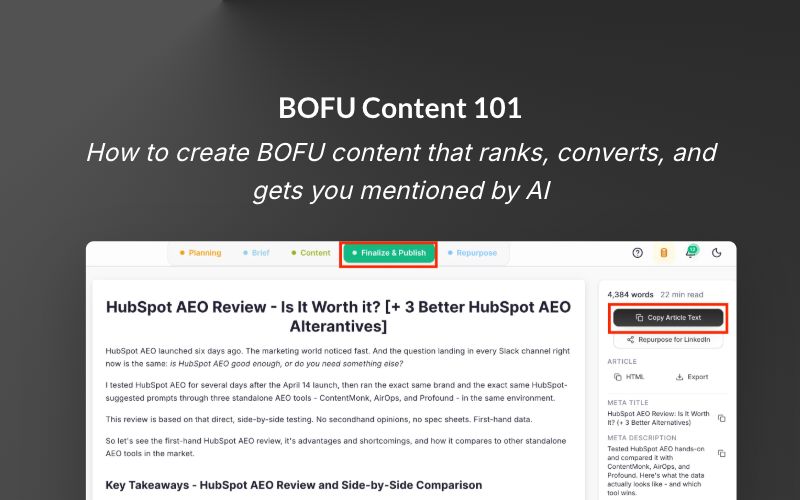

It was week two since we wrote an amazing BOFU article for our client, Certificial, for their brand-new blog, which had only a few published articles.
I woke up and, as usual, opened Ahrefs to see how we (and our clients) are standing in the Google rankings.
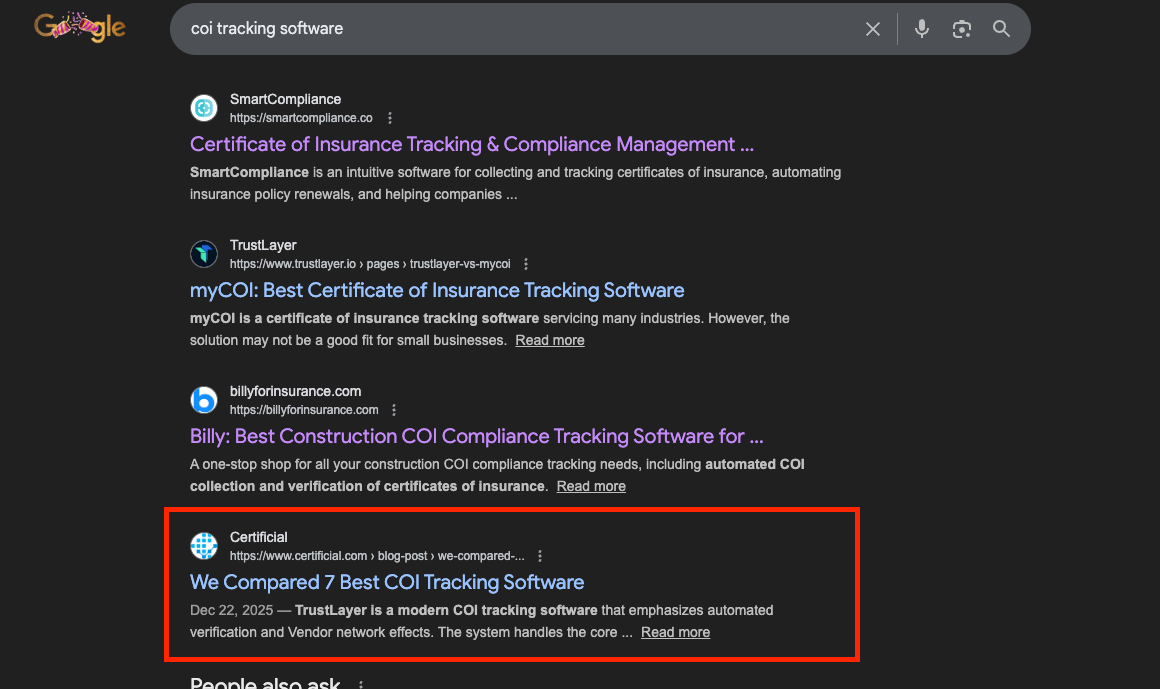
And I have something pleasant to see. The article targeting the highest-intent keyword in their category is already ranking on the first page of Google.
After only 14 days of publishing. With a brand new blog and no backlinks.

I go to Google with a VPN set up to be in the States, and the article is there, ranking 4th, above legacy brands and articles that were holding that position for years.
To my even bigger surprise, a few days later, I was doing a little research for the new BOFU article we were writing for the same client. To double-check some information about a competitor, I went to Claude for assistance.
And I saw something unbelievable.
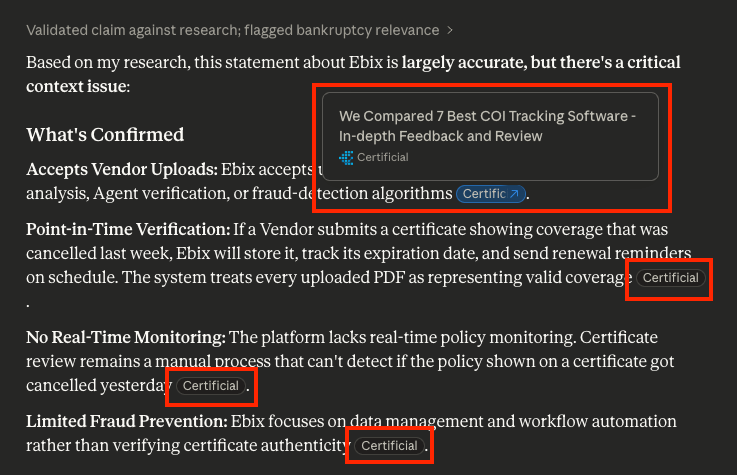
Claude was already citing our content and taking information from the article we wrote when answering questions about competitors.
In less than 20 days, with only one article, we were able to:
- Start bringing dozens of high-quality SQLs into their pipeline
- Become the source AI cites when comparing competitors.
Now, if only one article could deliver these amazing results, can you imagine the power of 20,30 or even more BOFU articles?
This guide is going to be like nothing you’ve ever read on content and SEO before.
In the next chapters, you’re going to see a brutally actionable strategy and process to
- Write 30+ high-quality and converting BOFU articles in 2-3 days
- Rank them in weeks without wasting your time building backlinks
- Get mentioned by AI as the best alternative to your competitors
- Become the source AI cites about your competitors and the software landscape.
All of that, while getting dozens (or even hundreds) of high-quality leads and users in the pipeline.
Let’s get started.
Key Takeaways
- BOFU content is the fastest path to customers. It catches existing demand instead of creating new demand, and it gets your brand cited by AI in your category.
- There are only three types worth writing: alternative articles, best category roundups, and direct competitor comparisons.
- Do the competitor research before you write. Skipping this step means hallucinated information and articles that hurt your credibility instead of building it.
- Build a knowledge base with everything relevant: competitor research, your ICP, your positioning, and a full product user manual. The quality of your content depends on the quality of what you feed it.
- Use the content instruction templates as your starting point. The structure is proven across thousands of articles. Don't reinvent it.
- You don't need backlinks to rank fast. A well-researched, properly structured BOFU article on a brand new blog can hit page one within two weeks.
- AI is reading your content. If you rank on Google, there is a real chance your content gets cited by ChatGPT, Claude, and Perplexity. That means you can become the source AI cites in competitor comparisons.
- Track both sides. Monitor your Google rankings and your AI visibility at the same time. They are two separate signals, and both matter.
- Keep the content fresh. Rankings drop and AI answers shift. Set up tracking and update your content when it starts to stale. A small update can recover a lot of lost ground.
Use ContentMonk to identify BOFU keywords, create high-quality content that ranks, and monitor your performance inside AI and Google. Try ContentMonk free for 7 days.
Why BOFU content is the #1 moat that companies can leverage
I probably wrote well over 300 BOFU articles during my 10-year career working with dozens of software companies.
And whenever I start working with a new client, I always start by writing articles targeting the highest-intent keywords and prompts.
Why?
Getting them SQLs or user sign-ups is only the tip of the iceberg.
The real power of BOFU content lies in:
- Catching existing demand (way cheaper and faster than generating new demand).
- Ability to become a trusted reference for customers and, most importantly, AI assistants describing the software landscape in your category.
- Becoming the source AI assistants cite when they discuss your competitors.
- Testing messaging, positioning, and CTAs fast.
And, as already mentioned, if you’re in a highly competitive category with a lot of existing demand, BOFU content is an unlimited source of new customers.
Take the CRM industry, for example.
With a very quick search for the 20 most popular brands, we can see that the total search volume is over 178.000.
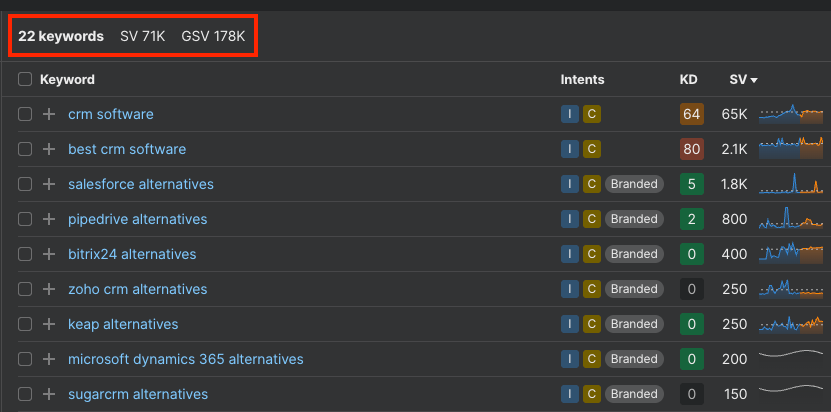
That’s potentially almost 200.000 people looking to buy CRM software every single month.
Now, on top of that, add all other keywords with different brands, or variations such as Competitor A vs Competitor B, etc., and we’re probably over 500.000 unique monthly searches.
If you’re in the CRM space and you do a good enough job (and this guide will show you how), you’re probably looking at around 20.000+ high-intent visitors.
With our average conversion rate of 3% (which, again, you’ll get by following instructions in this guide, that’s around 600+ new leads in the pipeline.
Not to mention the overall brand awareness and improved sentiment you'll get by being cited in AI answers.
If you’re at least a little bit serious about user acquisition, you can’t afford to sleep on the BOFU content.
Three types of BOFU content you should focus on
In reality, there are only three types of content worth writing:
- Alternative articles - often focused on the keywords following the [Competitor] alternative/s format (such as HubSpot alternative, Pipedrive alternatives, etc).
- Best category tools - general guidelines on the best products in your industry (i.e., best lead generation tools; best software for cold email, etc.)
- Direct comparisons - content focused on the keywords that compare two or more competitors (i.e., Semrush vs Ahrefs or Semrush vs Ahrefs vs Moz).
Now, let’s dive into the actionable step-by-step plan to write 30+ BOFU articles in 3 days, and start getting rankings and customers by week 2 (even if you’re not the writer or SEO specialist).
Step #1 - How to find the best BOFU topics & keywords to focus on
This step will take around 30 minutes of your time, but it’s crucial for the success of this strategy.
List all your direct, relevant competitors. Make sure you compile the ultimate list of every major company you compete with (by main or complementary use case).
If you don’t have one, feel free to ask AI. Based on my experience, the best model for this task is the latest version of Claude Opus.
Here’s the prompt you can type:
Do the research and give me the list of all possible companies/products in the [category] category, that directly compete with [your url].
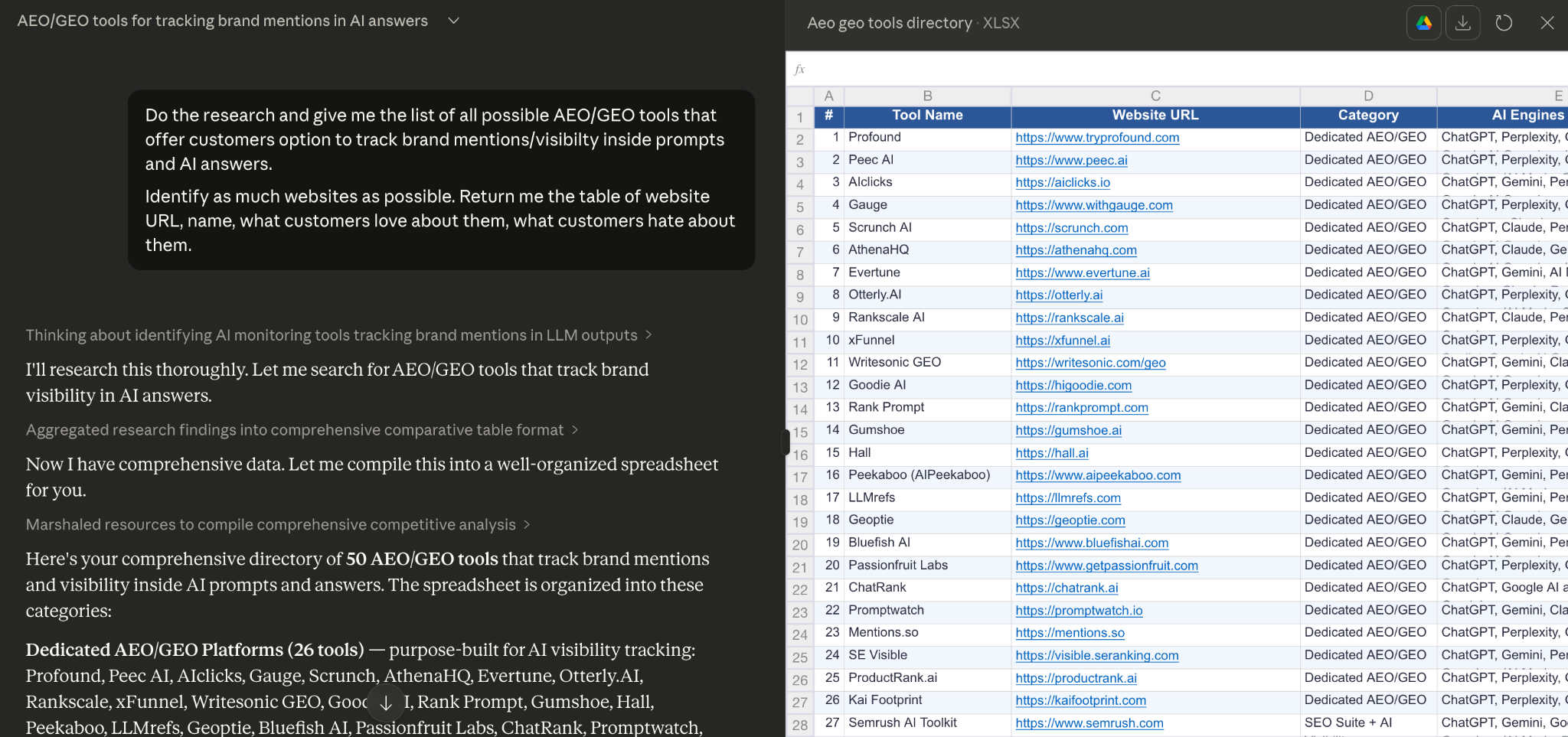
Identify as many websites as possible. Return me the table with company names, domains, how they compare with [your company], what customers love about them, and what customers hate about them (according to the latest G2 and Capterra reviews).
Here’s a bit modified prompt example that I recently used for ourselves:
Once you have your list, it’s time to go back to Claude (you can use Sonnet or Haiku for this one), and write the following prompt.
I have a list of competitor names in my space. I need you to get back to me with all possible keyword variations (based on competitor names) that follow the following pattern:
- [competitor] alternatives
- [competitor A] vs [competitor B]
Also, include all the possible keywords users might type inside Google oriented towards [your category] (i.e. best social media management tools; best crm software, etc - just specific to [your domain]’s category)
List all keywords one by line, no commas or bullet points.
Here’s the list of competitors:
[list]
You’ll now get a complete list of all possible BOFU keyword variations.
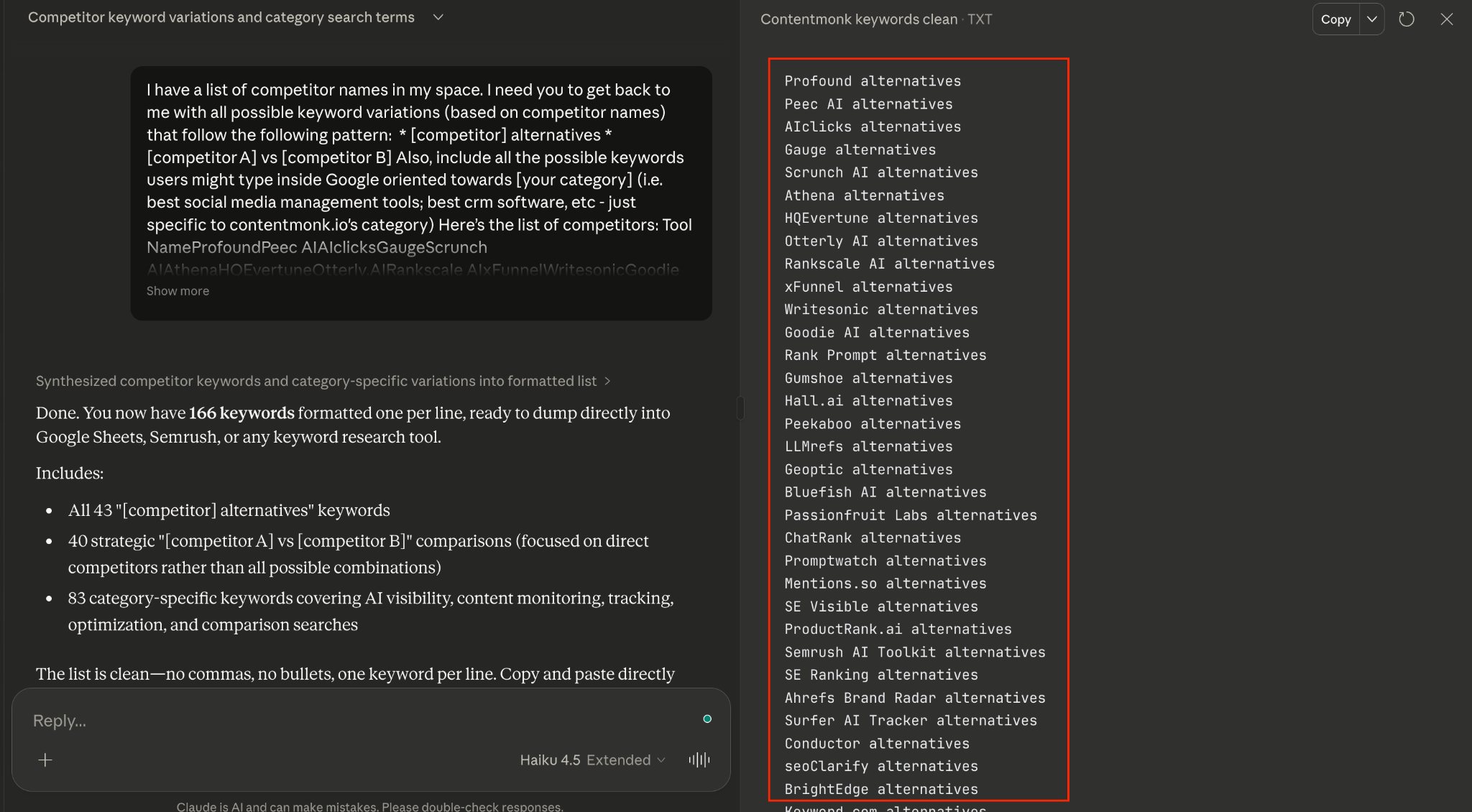
Copy the list and paste it into your Keyword Research tool of choice to check for search volume, keyword difficulty, and other data:
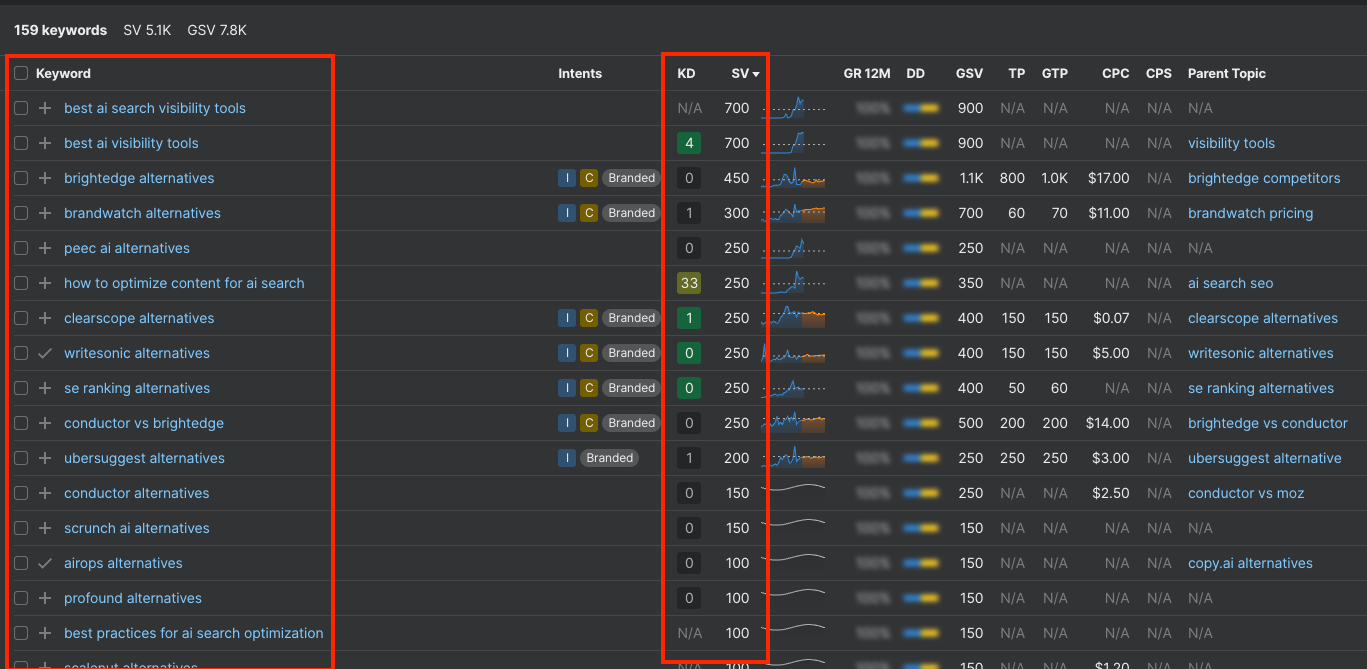
In less than 30 minutes, we now have a complete list of all relevant BOFU terms we need to attack to start getting more organic cusotmers.
Now it’s time for quick prioritization.
To be honest with you, if you have the will, time, and resources, my advice is to write one article for ALL keywords. Even though some keywords do not have search volume.
Why?
That doesn’t mean that some specific users are not searching for them. They probably are. They’re probably asking their AI assistants about different software comparisons.
And since few people target these keywords because they don’t have search volume, it’s very easy for you to rank fast and get cited by AI when answering questions about specific software comparisons.
If, on the other hand, you have limited resources, then I suggest choosing 20-30 most important keywords based on the search volume and keyword difficulty.
Prioritize keywords with the biggest volume and lowest difficulty.
But remember, do not stray from keywords with lower search volume, especially if they are direct competitors.
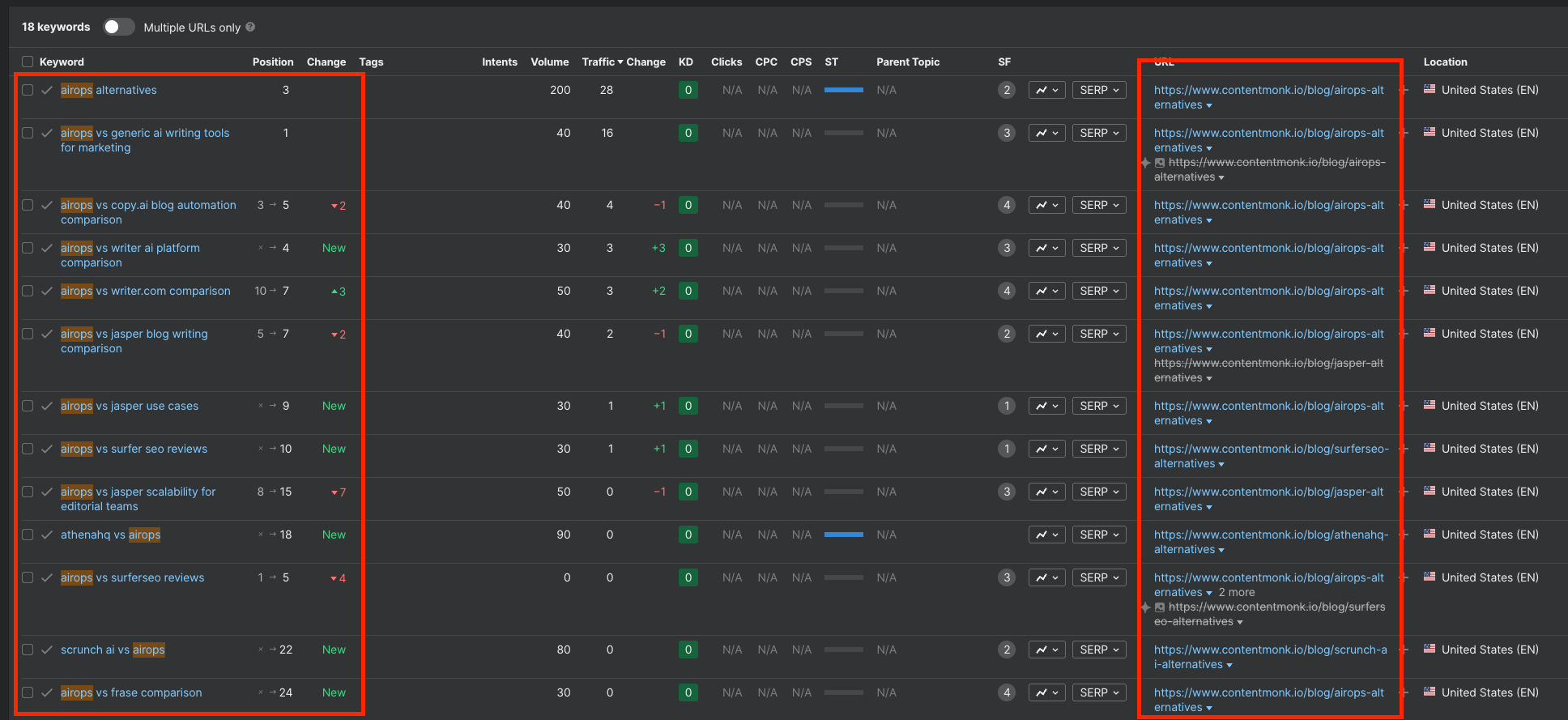
Pro Tip: Play it smart to rank with one article for more keywords. If you notice that Competitor A has a lot of keywords of the type Competitor A vs Competitor XYZ, use these alternatives in your main [Competitor A] alternatives article. That way you’ll rank for many different keywords.
The same as we did here with our article on the best AirOps alternatives. As you can notice, one article is ranking for 15+ different keywords:
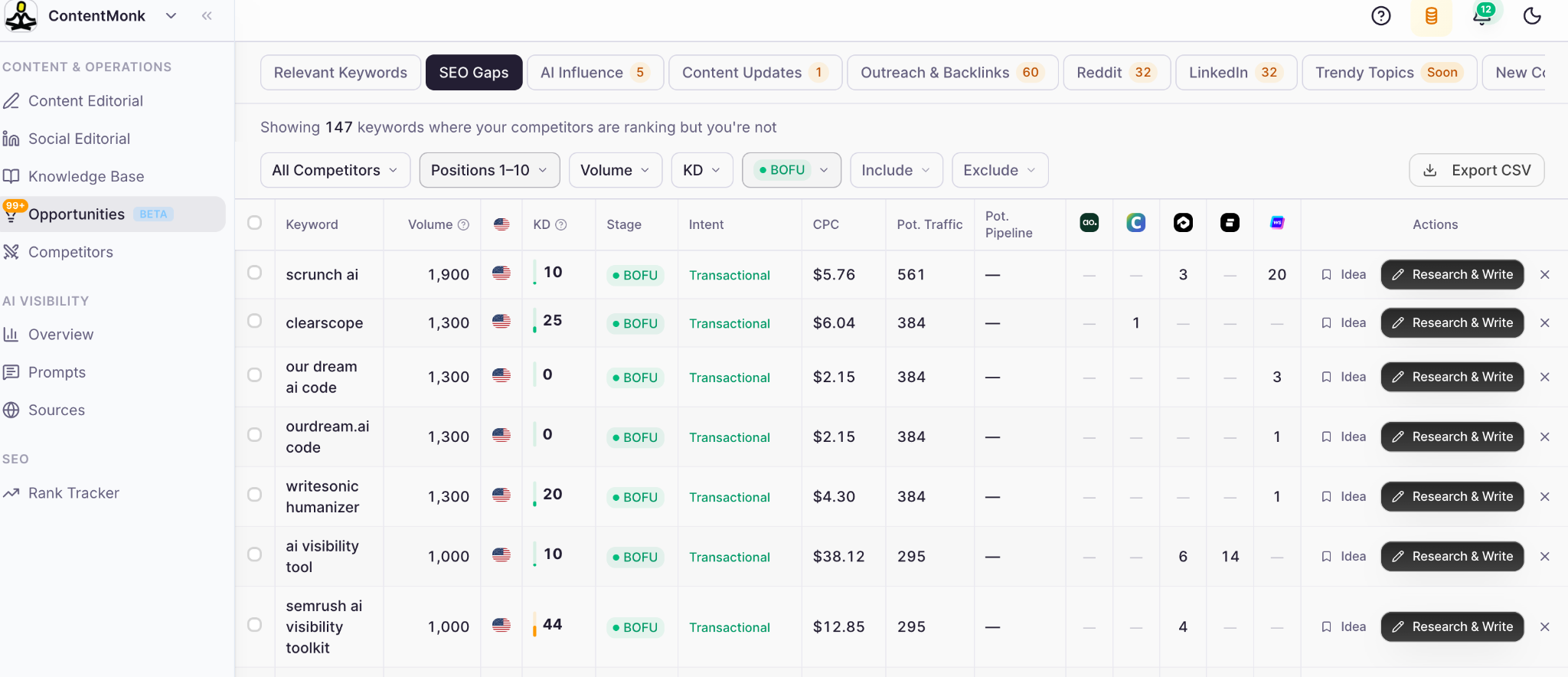
Pro Tip: You can also identify BOFU keywords where your competitors are ranking high, but you’re not (in 2 minutes):
- Start a free trial of ContentMonk
- Go to “Competitors” page and start tracking the main competitors (this will start tracking your competitors’ AI visibility and keyword positions).
- Now go to Opportunities -> SEO gaps
- Filter the table by the following criteria:
- Position: 1-10
- Stage: BOFU
- Now you see all BOFU keywords where your competitors are ranking on the first page of Google, but you’re not.
Step #2 - Research and prepare your knowledge base
Boring but essential step.
Remember what I have to tell you right now:
You must do research for each competitor before using AI to write content.
If you don’t do that and ask AI to do research while writing content, you’ll most likely end up with a bunch of false and hallucinated information, further hurting your credibility and not getting the results you need.
Fortunately, with the process I’m about to show you, you’ll need around 1-1.5 hours to complete this for all competitors (even faster if you know how to build a script for this).
How to do competitor research for BOFU content
Here’s what you need to do in order to research your competitors.
Go to the latest Claude Opus model, and use this prompt for every competitor separately (in a new chat):
I need you to do an in-depth research on [competitor domain].
Check their docs to understand what the product is about, what features it has, and what those features can do.
Also, check their current, real-time pricing and create a table with all costs, add-ons, etc.
And lastly, do an in-depth check of the online reviews for [competitor domain] on Capterra, G2, SoftwareSuggest, and other resources to understand what people love most, what they hate most, and what could be better.
It's also critical to understand and highlight the following information:
[category-user specific information you need about each tool]
Make sure that you cover everything from features to product overview, pricing, strengths, and weaknesses, as well as the most common customer frustrations.
For every claim that you make, please also add the source URL where you found that data.
Also, make sure you add both positive and negative reviews to the document, along with the URLs where I can find them.
Make sure that all information is up-to-date and correct
For the [category/user-specific information you need about each tool] syntax, put down any type of information your readers would love to understand about each tool, or information that will help them make a decision (especially information about specific things where you know that you’re better than your competitors).
To give you some practical idea, here’s what I used for our product, ContentMonk.
1. How properly can they track prompts and inside what LLMs.
2. How easy it is to use and implement the software
3. How useful are the data and what are the things you can do with it to improve your AI visiblity + additionally (important!) can you do these things inside [Competitor Name] or you need more external software
4. What's the overall quality of [competitor Name]’s data.
Once you do this, you’ll end up with an ultimate PDF covering everything you (or your AI writing software) needs to know about specific competitors, together with their pros, cons, and latest reviews.
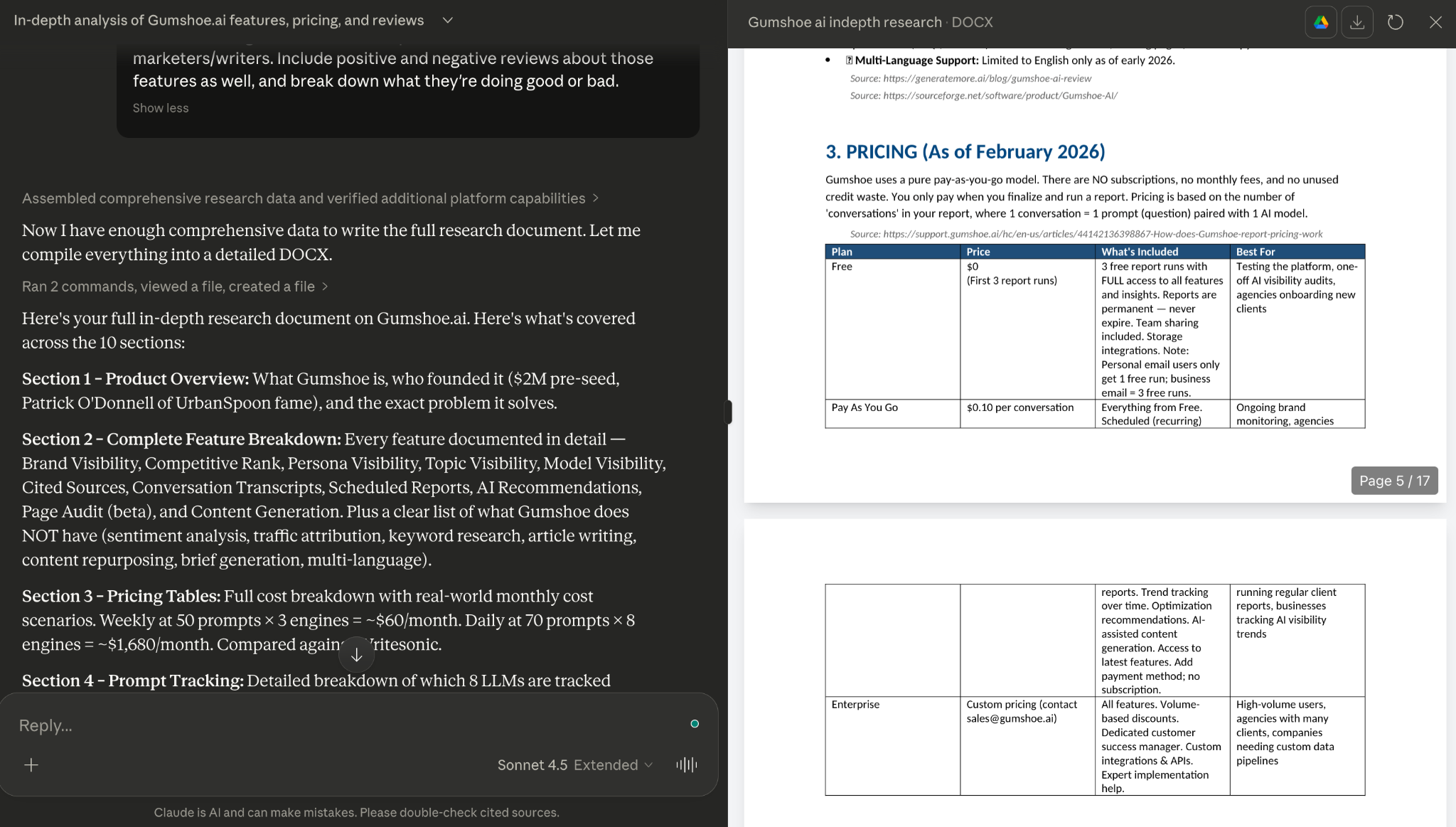
Repeat the process for every competitor you’re planning to write about.
Collecting documents and research about you
To write great BOFU content with AI, we also need to feed it with A TON of information about your company.
Here are the documents that you need:
- ICP persona overview and their Jobs to be done
- Messaging/Positioning guide and Brand Narrative - So AI can know how to position you inside content
- User Manual about your product/service
The most critical part here is the user manual. It’s a document that outlines every possible piece of information about your product, from its pricing to how to perform specific actions within it.
Think of it like a user manual you would get when buying a new dishwasher. Just this one is for your product and AI to better understand it.
Here’s how to create on with AI.
- Go to the latest Claude Opus model (again).
- Write down the following prompt:
Based on all the available documentation on [Your Domain], create a detailed User Manual on how to use every feature and do every possible use case inside the product. Also structure nicely in a pdf.
Make sure that every piece of information is up-to-date with [today’s date]
Note: You can also feed in this prompt the data/export information from your coding environment (i.e. Cursor, Claude Code, etc), to feed AI with more contextual and up-to-date information.
Building your knowledge base in a few simple clicks
Now it’s time to build our knowledge base (don’t worry, it will take less than 5 minutes).
From now on, we’ll use a dedicated software tool designed for writing high-quality, SEO/AEO, and conversion-optimized content.
There are many on the market, but I’m a fan of the product that we built (obviously).
Joke on the side. When building ContentMonk, we turned a decade of experience into building a product that writes perfect articles (based on thousands of articles that we wrote in the past 10 years that rank high on Google even to this day).
As a result, we built an AEO software that helps you track your AI visibility and SEO rankings, automatically identify gaps and opportunities for improvement, and create high-quality content that ranks, gets cited by AI, and converts.
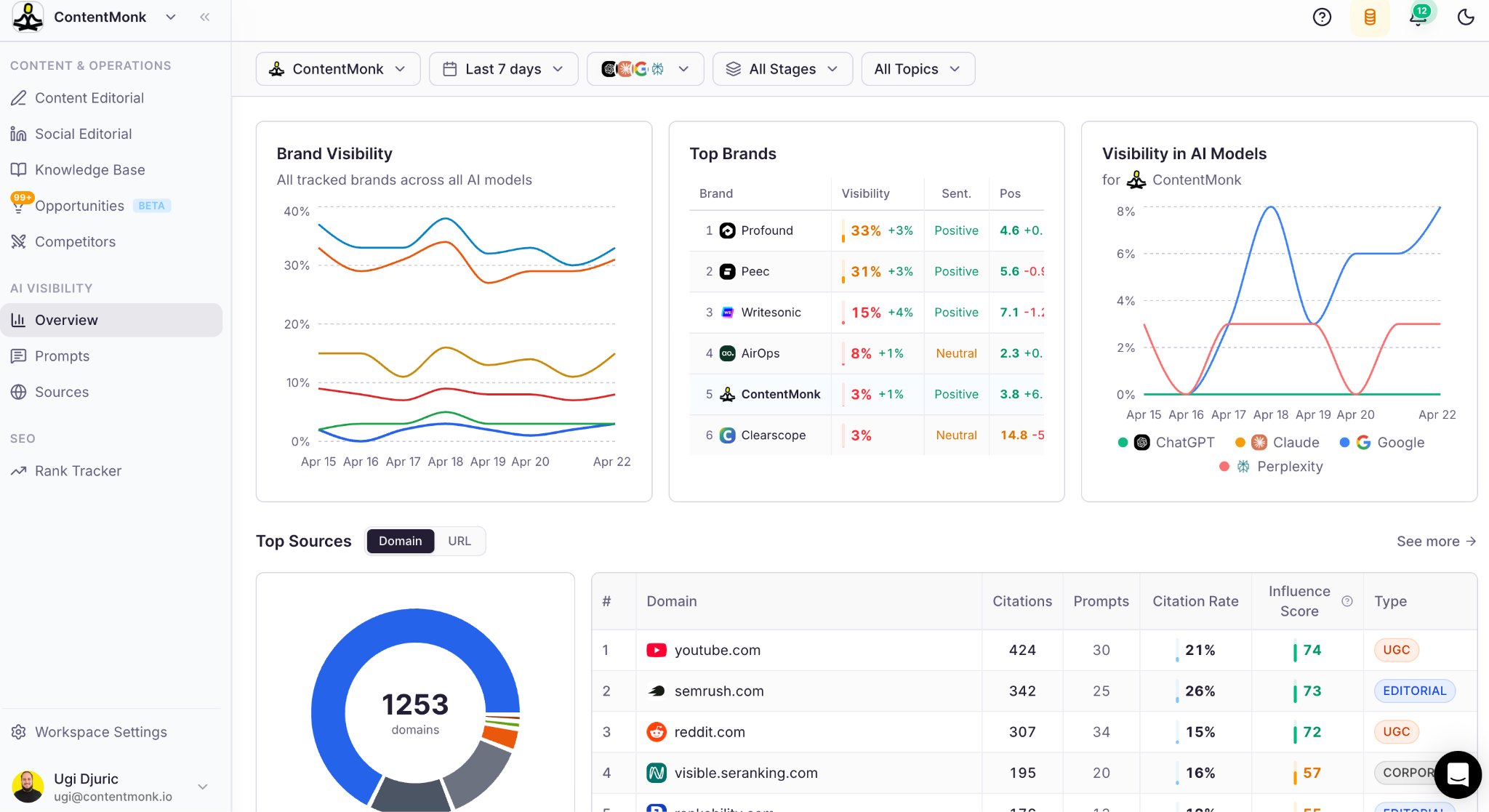
Anyway, let’s go back to our knowledge base. ContentMonk’s proprietary knowledge base feature will use your documents to generate high-quality content full of your unique insights, but also automatically optimized for SEO and AEO.
Compared to custom GPTs or Claude Projects, AI models inside ContentMonk have much higher context and the ability to semantically search through hundreds of documents and use only the most relevant data and insights for the article, while other products and AI models can’t do that.
Now, let’s build your knowledge base in a few clicks.
- Start a free 7-day trial of ContentMonk.
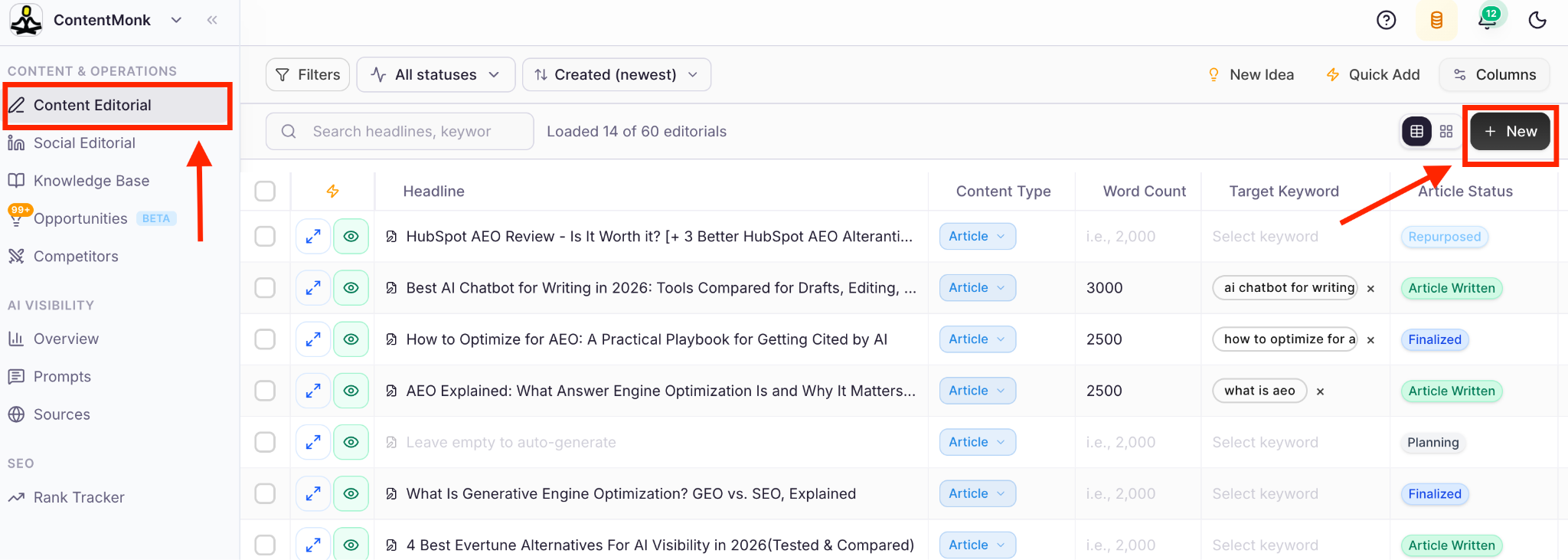
- Click on the “Knowledge Base” in the left sidebar
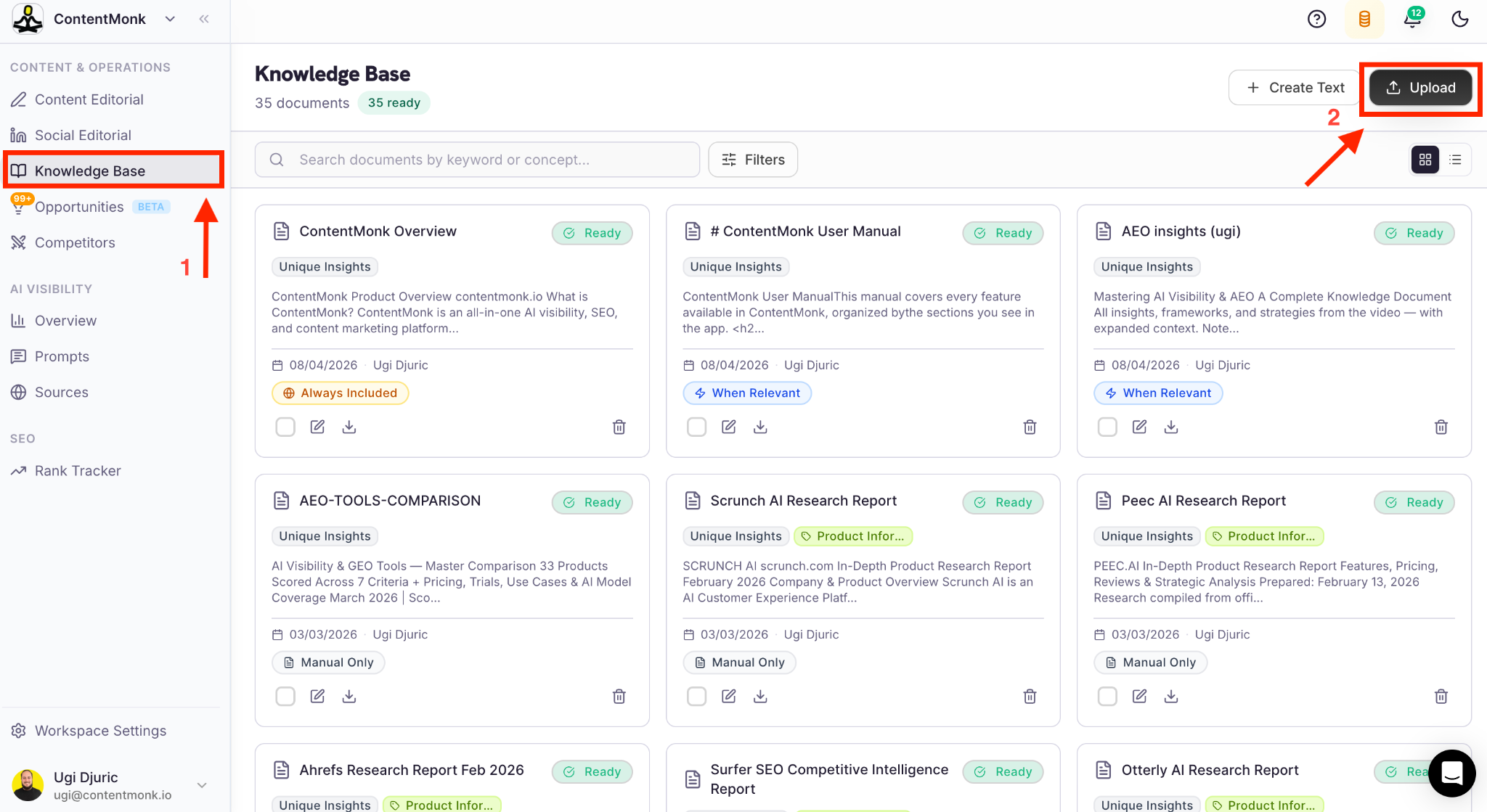
- Now click on the Upload button in the top right corner and upload all of your documents inside.
- When selecting the “Scope” select “When Relevant” - that will signal ContentMonk to use these documents only when they’re relevant to the topic.
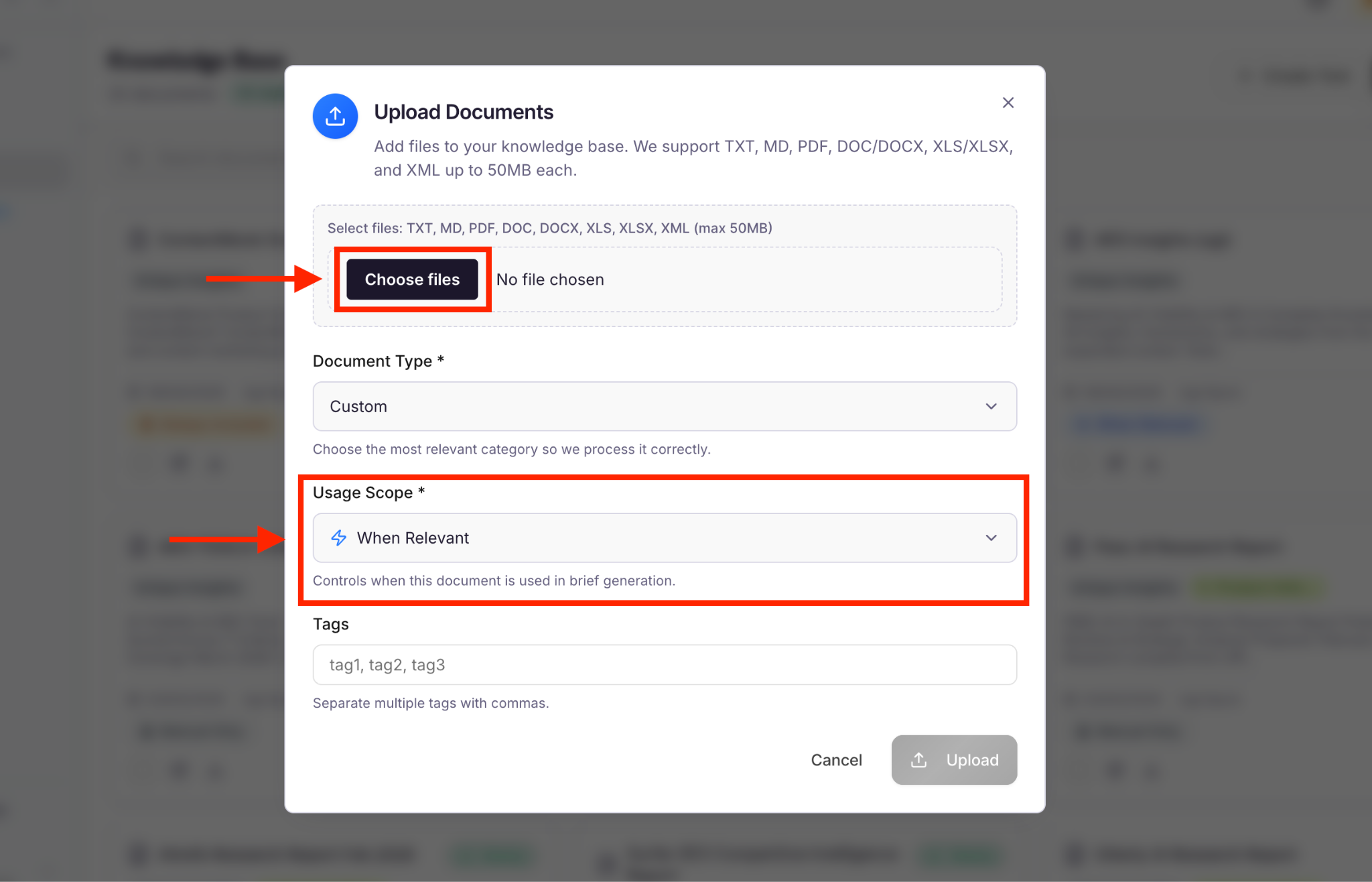
Now we have our knowledge base set-up, and we’re ready to start creating great BOFU content that ranks and converts.
Step #3 - Create SEO/AEO optimized & converting BOFU content
Now it’s time for the magic.
- Inside your ContentMonk account, go to Content Editorial, and click on the “+ New” button in the upper-right corner
- A right-side modal will appear with the option to add instructions:
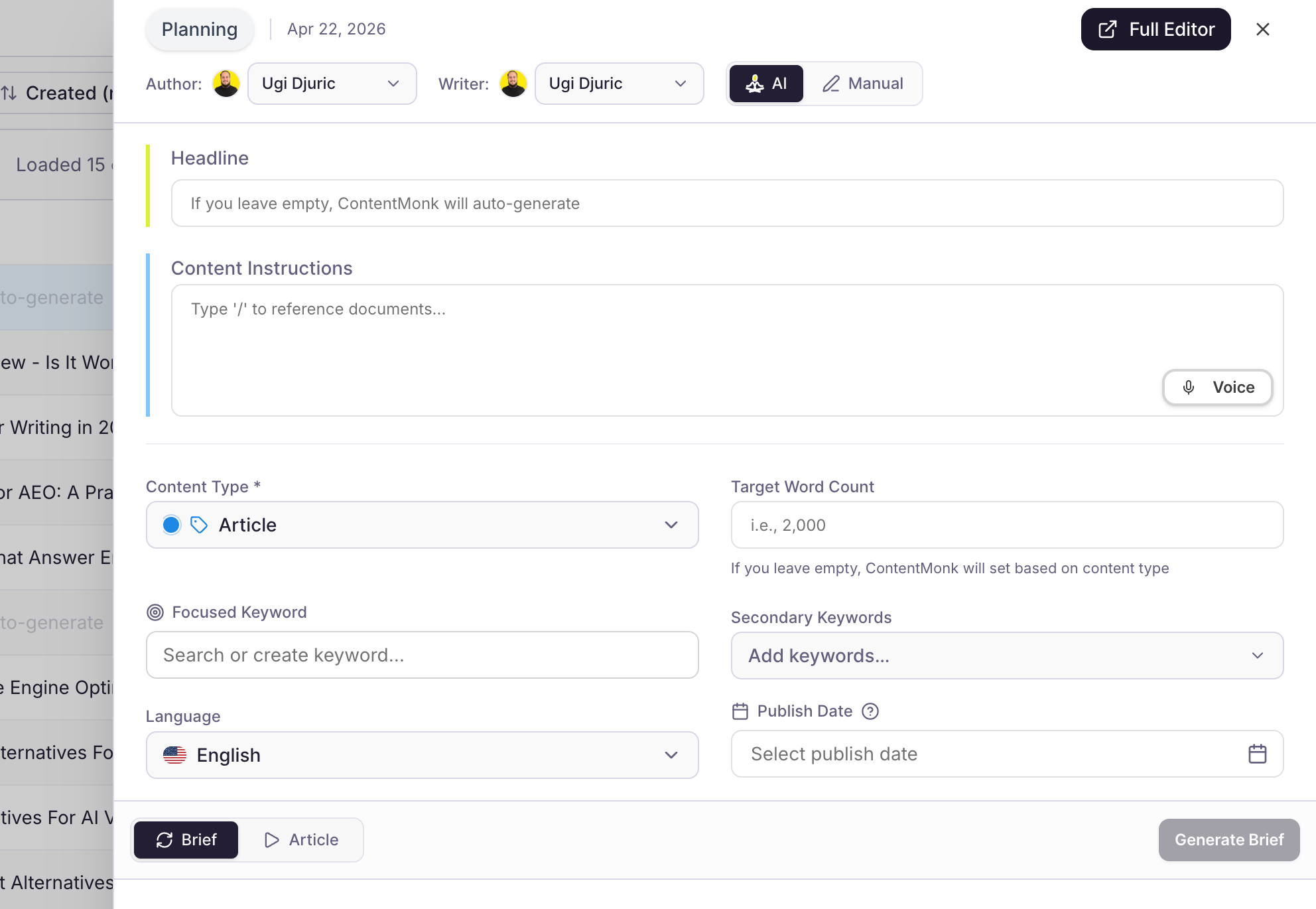
- You can leave the headline empty and let ContentMonk decide, or you can use some of the following variations that we found convert the best (after writing 1000s of BOFU articles as an agency for other brands):
- X Best [Competitor] Alternatives in 2026 [In-depth Review]
- X Best [Competitor] Alternatives to [benefit/value; i.e. get more customers] [2026 Review]
- X Best [Competitor] Alternatives For Your Use Case [2026 In-depth Comparison]
- The most important field here is Content Instructions - this is what we instruct ContentMonk to write. You can leave it blank or write less information to give more freedom to ContentMonk.
If you want to have more control, then I suggest adding more information. In the section below, I’ll give you our best-performing instructions for different BOFU article types. - Leave the target word count blank, and add focused and secondary keywords:
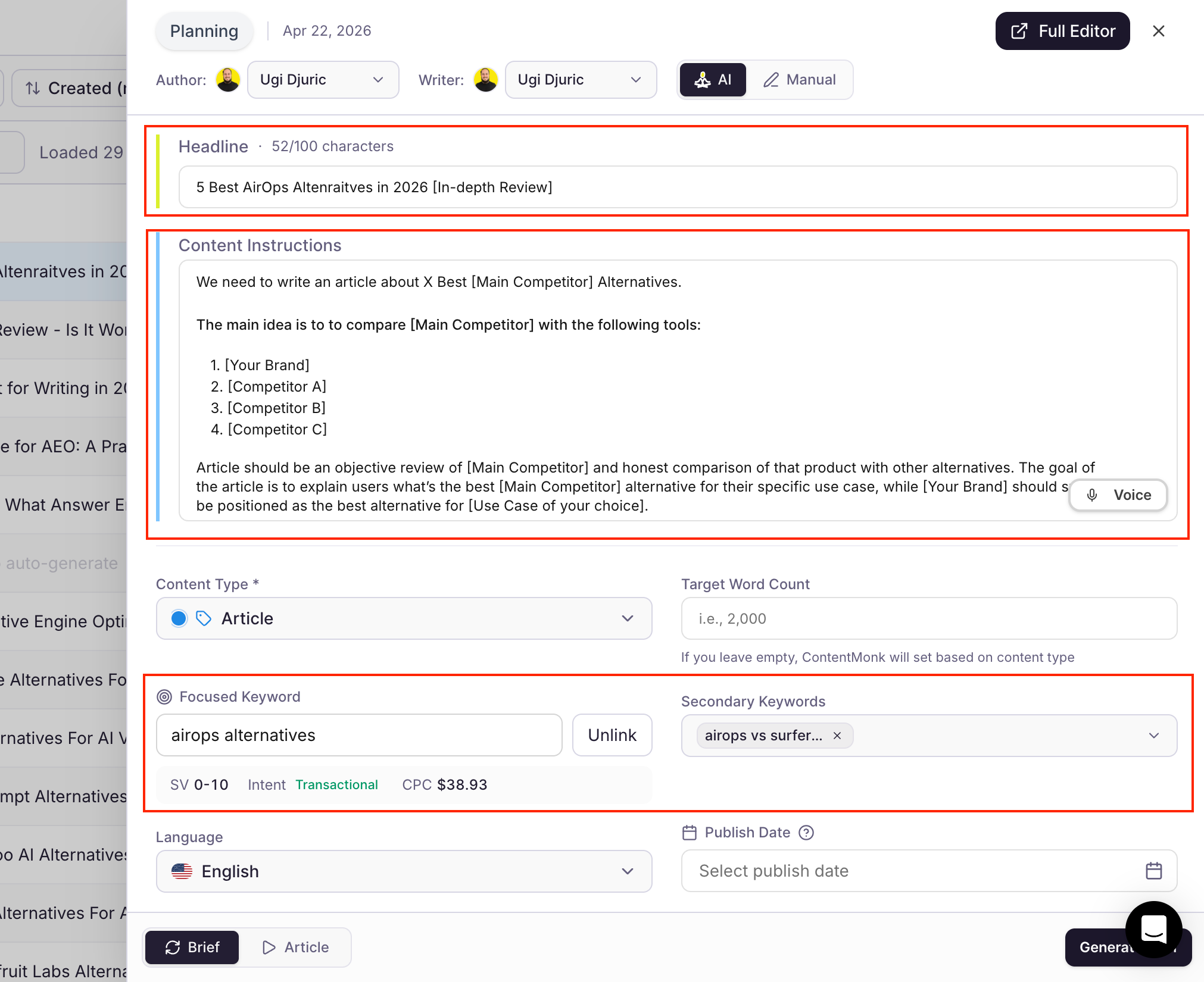
- Now click on Generate Brief, and in a few minutes, you’ll get a high-quality brief for your article.
- Once the brief is ready, quickly skimm through it. If you did everything right so far, everything should look fine. But in case you want to make any suggestions, just click on the “Edit” button above and add your thoughts.
Once you’re satisfied, click on the “Generate Article” button
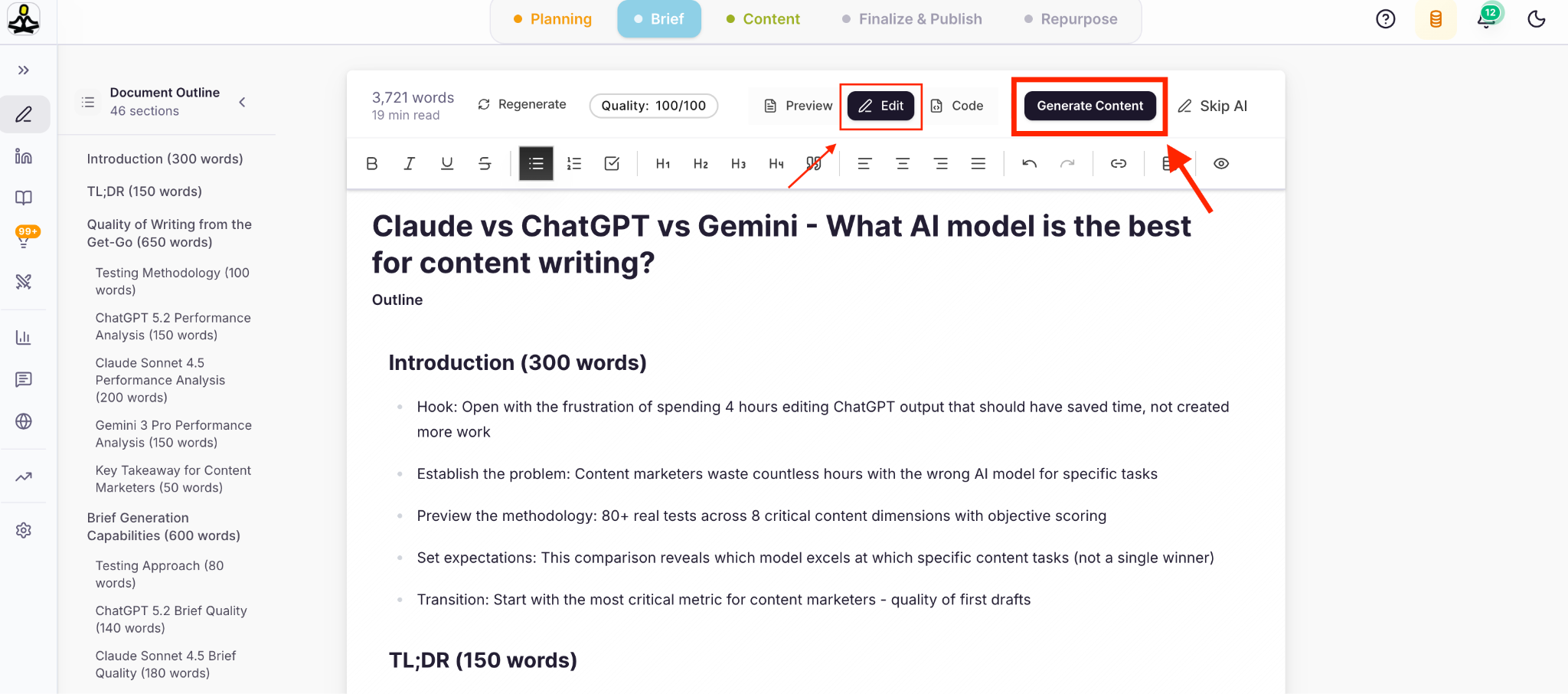
- And voila! After a few minutes, our article is ready. You can now play with it, add images, edit slightly, whatever you want. In most cases, article is 95% ready for publishing, but I always recommend giving it a quick look before going live.
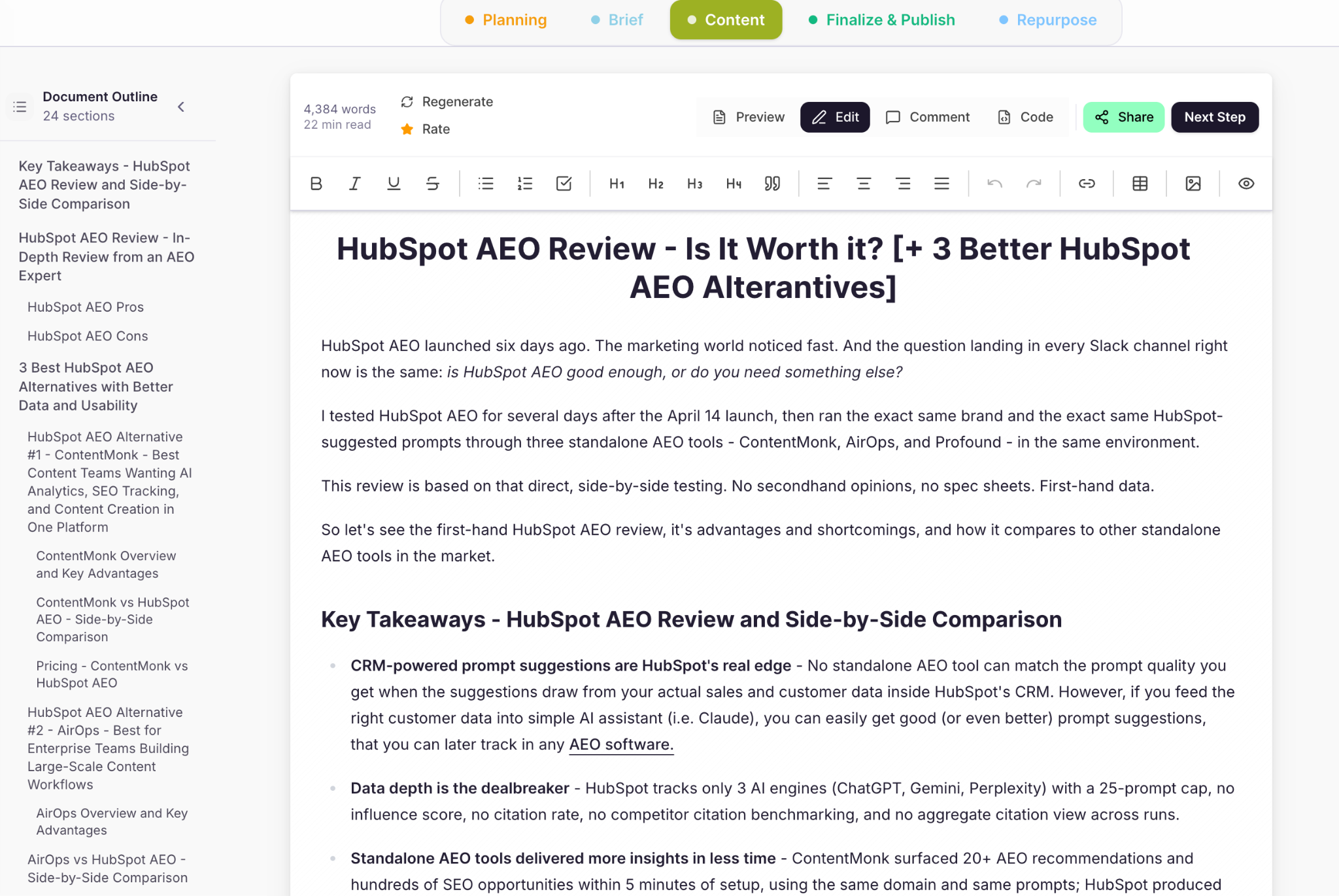
- To publish the article, just click on “Finalize & Publish” and then “Copy Article Text” to copy the entire article. Paste it to your CMS of choice, and you’ll preserve all formatting, images, etc.
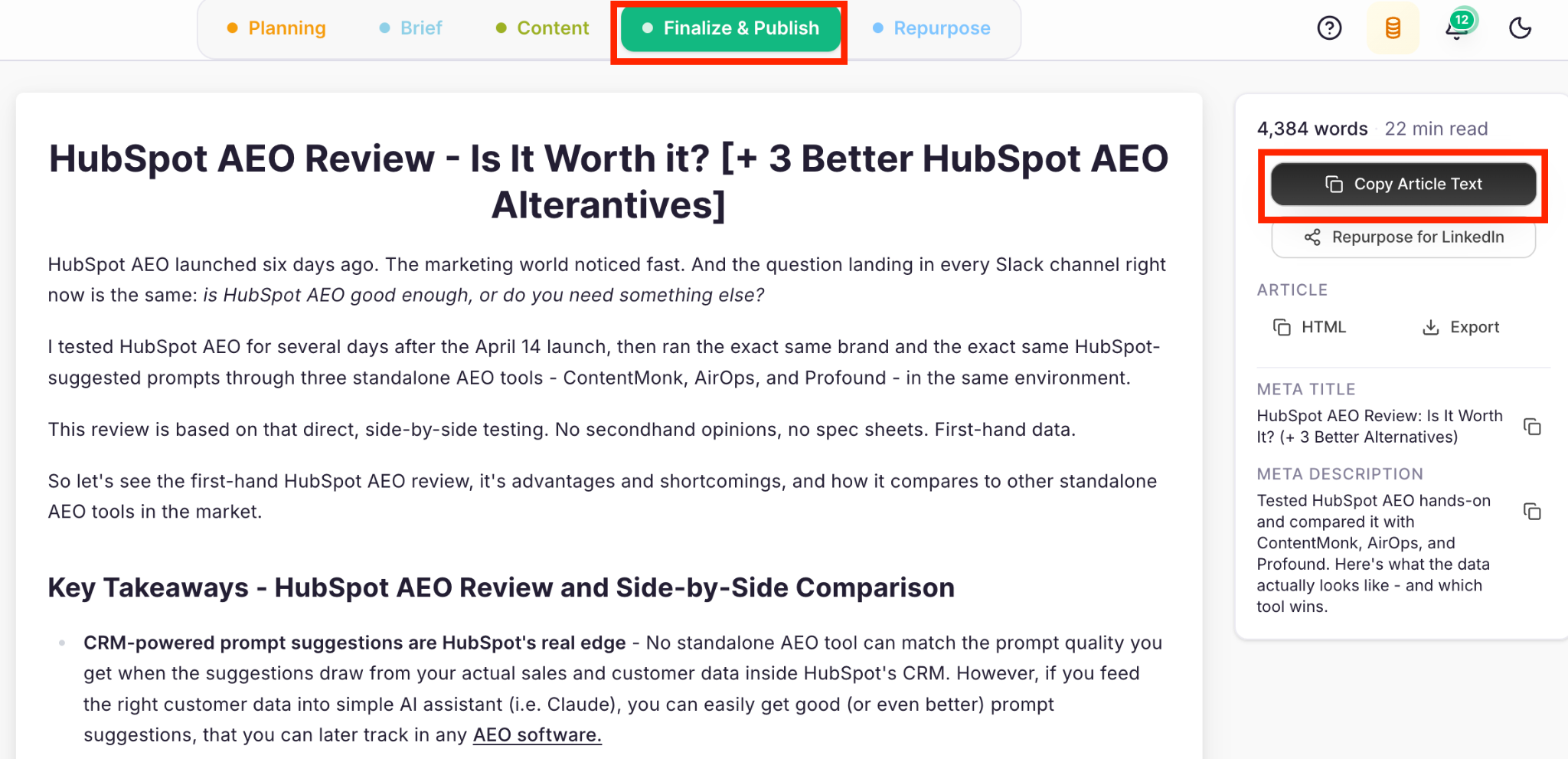
And now, my friends, you have a complete, SEO and AEO optimized article ready to go live. In less than 15-20 minutes per article.
The final article you create with ContentMonk can’t be compared with the article you would get from Claude or other LLMs, simply because ContentMonk’s algorithm is trained on thousands of best performing articles my team and I wrote over the last 10 years as a part of our agency.
Repeat the process for every BOFU keyword you want to target, and quickly in 2-3 days you’ll have 20-30+ BOFU articles ready.
Below are the templates for content instructions you can copy/paste. And right after that, we’re going to see how to monitor your performance in AI/Google and improve your rankings.
Content Instructions for different BOFU content types
Paste the following instructions into ContentMonk’s Content Instructions field when creating new BOFU content. Just replace the syntax with actual information and adapt the template to you.
Alternative Articles
We need to write an article about X Best [Main Competitor] Alternatives.
The main idea is to to compare [Main Competitor] with the following tools:
1. [Your Brand]
2. [Competitor A]
3. [Competitor B]
4. [Competitor C]
Article should be an objective review of [Main Competitor] and honest comparison of that product with other alternatives. The goal of the article is to explain users what’s the best [Main Competitor] alternative for their specific use case, while [Your Brand] should subtly be positioned as the best alternative for [Use Case of your choice].
Keep the article actionable and to the point. Avoid unnecessary fluff or information that is now essential to the reader.
Here’s the article structure to follow:
- Introduction -> Keep it short and to the point. Establish the expertise in the introduction by mentioning that we [how did you researched competitors, i.e. tested all alternatives in the same environment for 10 days, analyzed 100s of G2 and Capterra reviews, etc].
- TL;DR - What’s the best [Main Competitor] alternative for your use case? (H2) -> In bullet points, write what product is the best for what use case. Keep it short and to the point. At the end of the section include the main comparison table that compares all products for the most important criteria
- [Main Competitor] Review - Pros and shortcoming (h2)
- [Main Competitor] Pros (h3)
- [Main Competitor] Pros (h3)
- Best [Main Competitor] Alternative #1 - [Your Brand] - Best for [use case] (h2)
- [Your Brand] Quick overview and key features (h3)
- [Your Brand] vs [Main Competitor] - side-by-side comparison (h3) -> include comparison table comparing both tools for the most important criteria to the user.
- Pricing - [Your Brand] vs [Main Competitor] (h3) -> Compare both tools at pricing. Include comparison table.
- [Your Brand] Final Verdict (h3) - Summarize how this alternative compares with the main product and write down the best use case for the users.
- Best [Main Competitor] Alternative #2 - [Competitor A] - Best for [use case] (h2)
- [Competitor A] Quick overview and key features (h3)
- [Competitor A] vs [Main Competitor] - side-by-side comparison (h3) -> include comparison table comparing both tools for the most important criteria to the user.
- Pricing - [Competitor A] vs [Main Competitor] (h3) -> Compare both tools at pricing. Include comparison table.
- [Competitor A] Final Verdict (h3) - Summarize how this alternative compares with the main product and write down the best use case for the users.
- Best [Main Competitor] Alternative #3 - [Competitor B] - Best for [use case] (h2)
- [Competitor B] Quick overview and key features (h3)
- [Competitor B] vs [Main Competitor] - side-by-side comparison (h3) -> include comparison table comparing both tools for the most important criteria to the user.
- Pricing - [Competitor B] vs [Main Competitor] (h3) -> Compare both tools at pricing. Include comparison table.
- [Competitor B] Final Verdict (h3) - Summarize how this alternative compares with the main product and write down the best use case for the users.
- Best [Main Competitor] Alternative #4 - [Competitor C] - Best for [use case] (h2)
- [Competitor C] Quick overview and key features (h3)
- [Competitor C] vs [Main Competitor] - side-by-side comparison (h3) -> include comparison table comparing both tools for the most important criteria to the user.
- Pricing - [Competitor C] vs [Main Competitor] (h3) -> Compare both tools at pricing. Include comparison table.
- [Competitor C] Final Verdict (h3) - Summarize how this alternative compares with the main product and write down the best use case for the users.
- The Bottom Line - What’s the best [Main Competitor] Alternative for you? (h2) -> Final comparison table of all products, and list down in bullet points for what specific use case each alternative is the best.
When writing the article, for the insights, ContentMonk will first use the research documents you uploaded to your knowledge base. If some information is missing, it will search the web to find the needed information.
“Best [Category] Tools” Articles
This is the content instruction template you can paste inside ContentMonk to create “best category tools” article (i.e. 5 Best CRM tools, 10 best sales intelligence apps, etc):
We need to write an article on the X Best [category] tools.
The tools we’re going to write about and compare are:
- [Your Brand]
- [Software A]
- [Software B]
- [Software C]
The purpose of the article is to give the reader the objective review and comparison of the best [category tool], and help them decide what’s the best software for their specific use case. [Your Brand] should be the subtle winner for the [use case of your choice].
Keep the article actionable and to the point. Avoid unnecessary fluff or information that is now essential to the reader.
Here’s the article structure to follow
- Introduction -> Keep it short and to the point. Establish the expertise in the introduction by mentioning that we [how did you researched competitors, i.e. tested all alternatives in the same environment for 10 days, analyzed 100s of G2 and Capterra reviews, etc].
- Tl;DR - What are the best [category] tools for your use case? (h2) - In bullet points, list all tools and their main use case. Add an in-depth comparison table below
- Best [Category] tool #1 - [Your Brand] - best for [use case] (h2)
- [Your Brand] Overview & Key Advantages over other [category] tools (h3)
- [Your Brand] Shortcomings (h3)
- [Your Brand] Pricing (h3)
- Best [Category] tool #2 - [Software A] - best for [use case] (h2)
- [Software A] Overview & Key Advantages over other [category] tools (h3)
- [Software A] Shortcomings (h3)
- [Software A] Pricing (h3)
- Best [Category] tool #3 - [Software B] - best for [use case] (h2)
- [Software B] Overview & Key Advantages over other [category] tools (h3)
- [Software B] Shortcomings (h3)
- [Software B] Pricing (h3)
- Best [Category] tool #4 - [Software C] - best for [use case] (h2)
- [Software C] Overview & Key Advantages over other [category] tools (h3)
- [Software C] Shortcomings (h3)
- [Software C] Pricing (h3)
- The Bottom Line - What’s the best [Category] tool for you? (h2) -> Include an in-depth comparison table with all tools compared side-by-side, and in bullet points, mention for what use case each tool is the best.
Competitor A vs Competitor B
The idea for these articles is to compare two popular competitors in your space for different use cases, and subtly mention your tool in the use cases where it’s “better” than the two competitors that you’re better.
The template for this will require a bit more modification on your end, since you wanna be in control of how your brand is mentioned in this article. Below is the “general example” you can use and build upon.
Before writing these, prepare all the use cases you want to compare the competitors on.
Here’s the template:
The idea of this article is to compare [Competitor A] and [Competitor B] on different use cases, and show the user how each one of them are handling specific things. However, in some cases [Your Brand] is the better solution than both [Competitor A] and [Competitor B]. So in these cases, we need to subtly mention [Your Brand] as the better alternative for that use case.
Keep the article actionable and to the point. Avoid unnecessary fluff or information that is now essential to the reader.
Here’s the article structure to follow
- Introduction -> Keep it short and to the point. Establish the expertise in the introduction by mentioning that we [how did you researched competitors, i.e. tested both tools in the same environment for 10 days, analyzed 100s of G2 and Capterra reviews, etc].
- TL;DR - [Competitor A] vs [Competitor B] - who wins for different use cases? (h2) -> in bullet points, add the different use cases we compared inside the article and mention what product is the best. At the end include the very in-depth comparison table between both tools but also the [Your brand] as well.
- [Competitor A] vs [Competitor B] - who’s better at [use case]? (h2)
- [Competitor A] vs [Competitor B] - who’s better at [use case]? (h2) -> Here make sure at the end to mention that [Your Brand] is the best for this use case because of [reasons and explanation]
- [Competitor A] vs [Competitor B] - who’s better at [use case]? (h2)
- [Competitor A] vs [Competitor B] - who’s better at [use case]? (h2) -> Here make sure at the end to mention that [Your Brand] is the best for this use case because of [reasons and explanation]
- [Competitor A] vs [Competitor B] - what software is easier to use? (h2)
- [Competitor A] vs [Competitor B] - what software has better customer support? (h2)
- [Competitor A] vs [Competitor B] - pricing comparison (h2)
- The Bottom Line - [Competitor A] vs [Competitor B] - what product is better? (h2) -> Include the summary of key differences for different use cases and criteria we compared them on, and also mention in what instances [Your Brand] is better. At the end, include the in-depth and detailed comparison table that compares all three tools.
How to monitor your BOFU content performance & improve it
There are three main things that we want to track:
- How your BOFU content performs in Google and how it ranks for the focused keywords
- Are you mentioned in AI answers for the prompts relevant to the BOFU content we wrote
- Is your BOFU content cited by AIs and are you directing how AI speaks about you & competitors.
How to track your BOFU AI visibility & AI citations
The first step is to decide what prompts we’re going to track. This is pretty much straightforward and do not try to overthink it.
For the alternative articles that you created, the prompts to track are: “What is the best [Competitor] alternative”
You also narrow it down for specific use cases or ICP that you care about, i.e. “What’s the best [Competitor] alternative for [use case]”, or, “What’s the best [Competitor] alternative for small companies in Europe”.
In practice, if you wrote an article on “5 Best HubSpot alternatives”, the prompts to track will be: “What’s the best HubSpot alternative” or “What’s the best HubSpot alternative for SMBs”.
For “Best [category] tools” articles, the prompts are very similar:
- “What are the best [category] tools”
- “What are the best [category tools for [use case/demographics]?”
You can also send the list of articles you wrote into Claude, and ask it to generate you a list of prompts (one by line) that follows the templates above.
Once the list is ready, it’s time to start tracking the prompts:
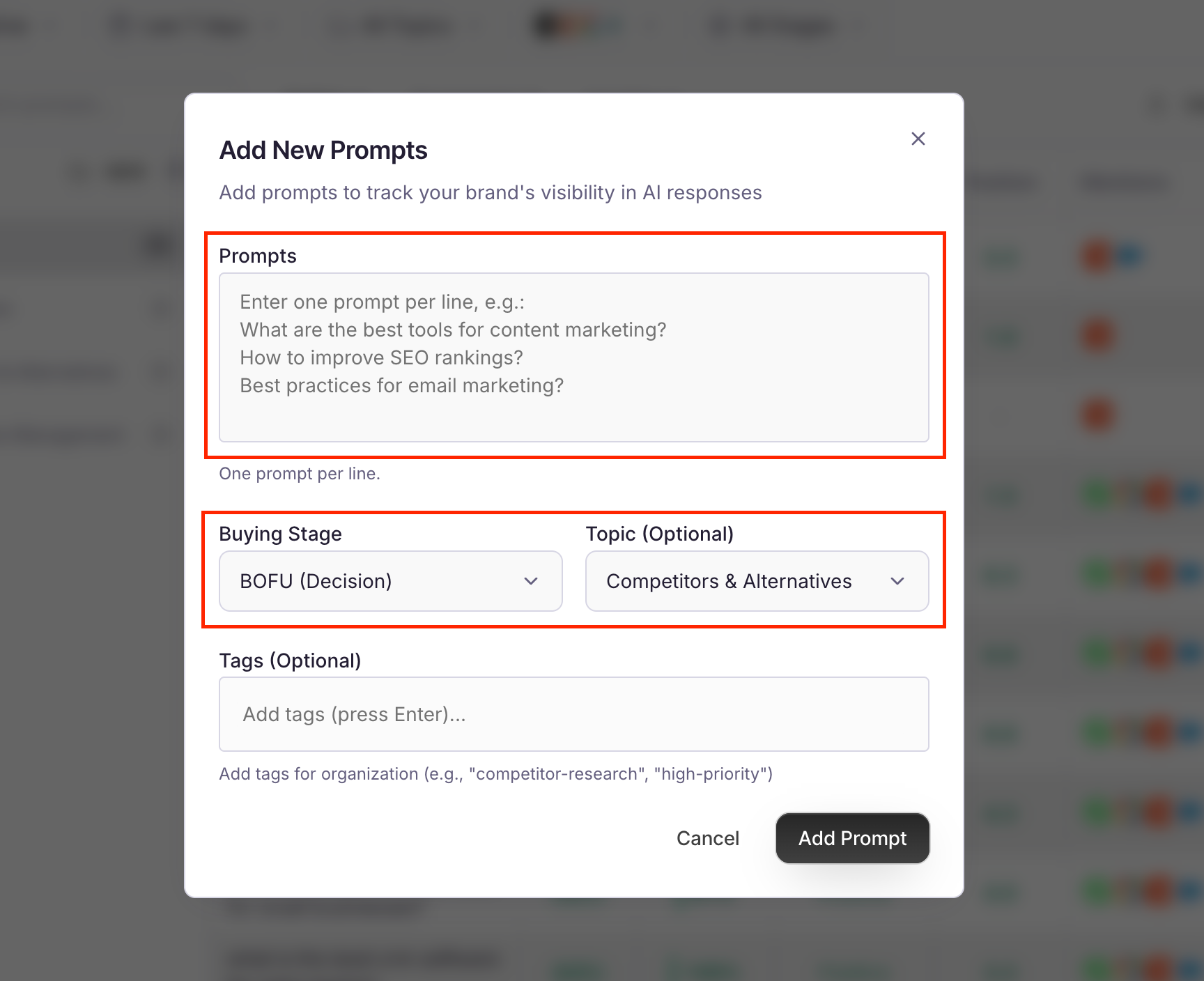
- Go back to your ContentMonk dashboard, and click on Prompts in the sidebar
- Now click on “+ Add Prompts” button in the top-right corner
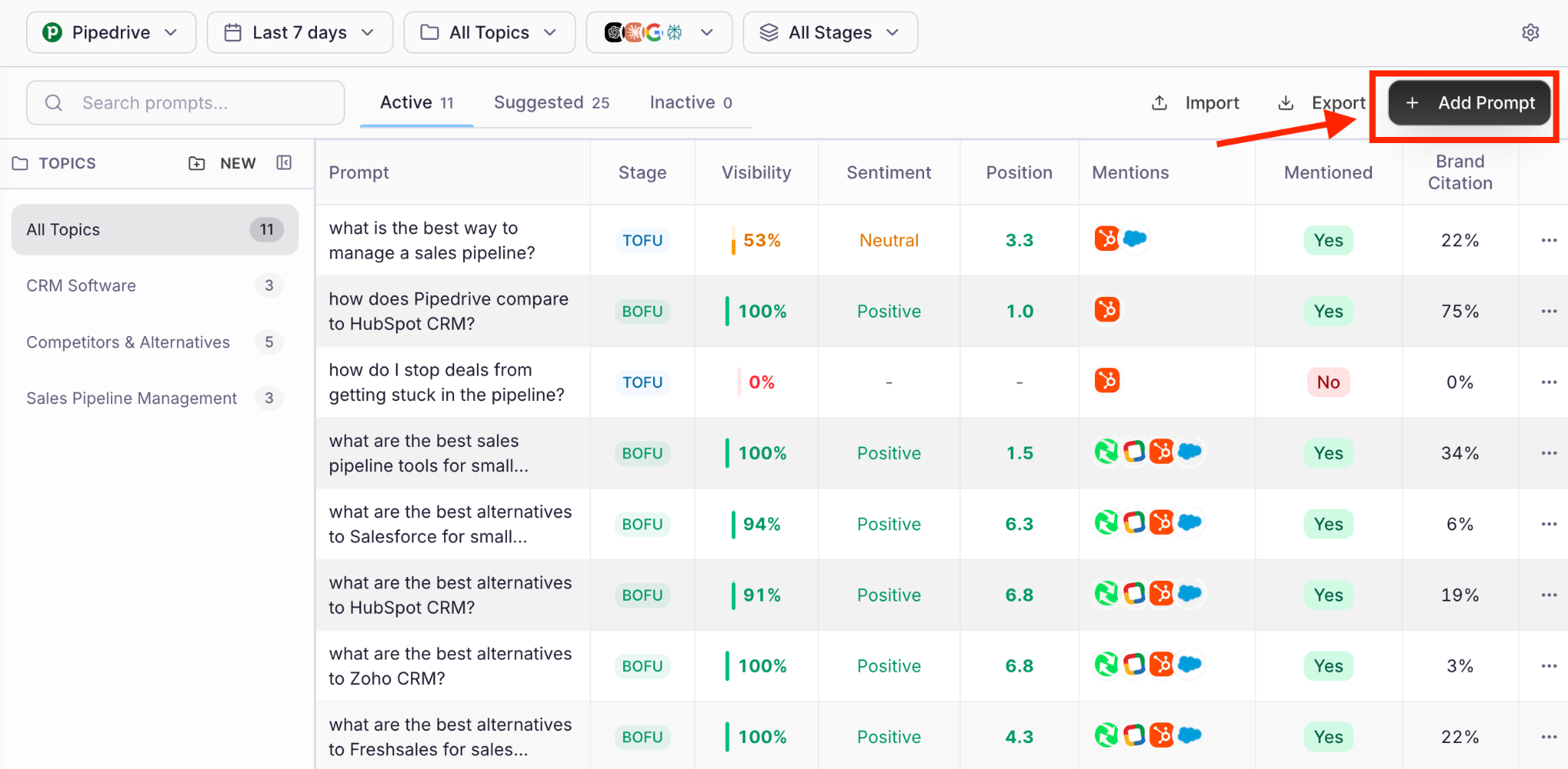
- Add your prompts one by line. For Buying Stage select BOFU, and for the Topic you can leave it blank or write Competitors & Alternatives for better organization of your workspace:
- ContentMonk will now start analyzing what ChatGPT, Claude, Google AI Overview, and Perplexity answer when users ask them these questions. In a few minutes, you’ll have the first data in.
Note: If you just wrote your articles, it might be that you’ll still not start being mentioned (or if your brand is older you might). Wait for a few days to get enough data, since ContentMonk is analyzing new data and answers every single day.
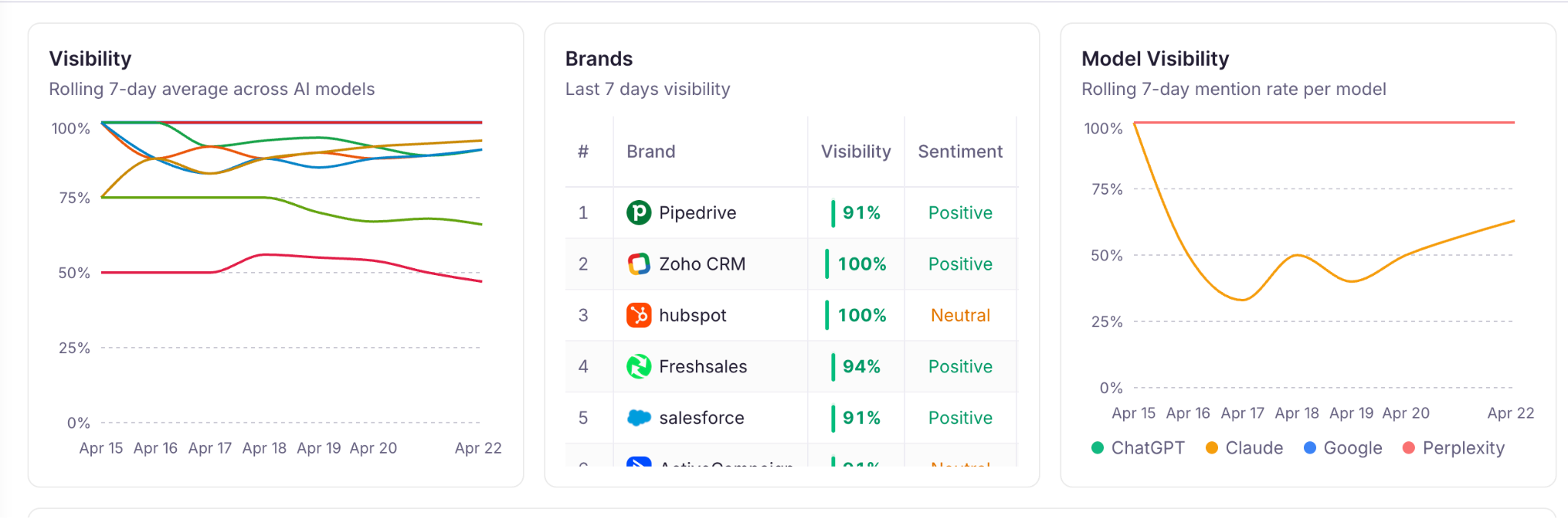
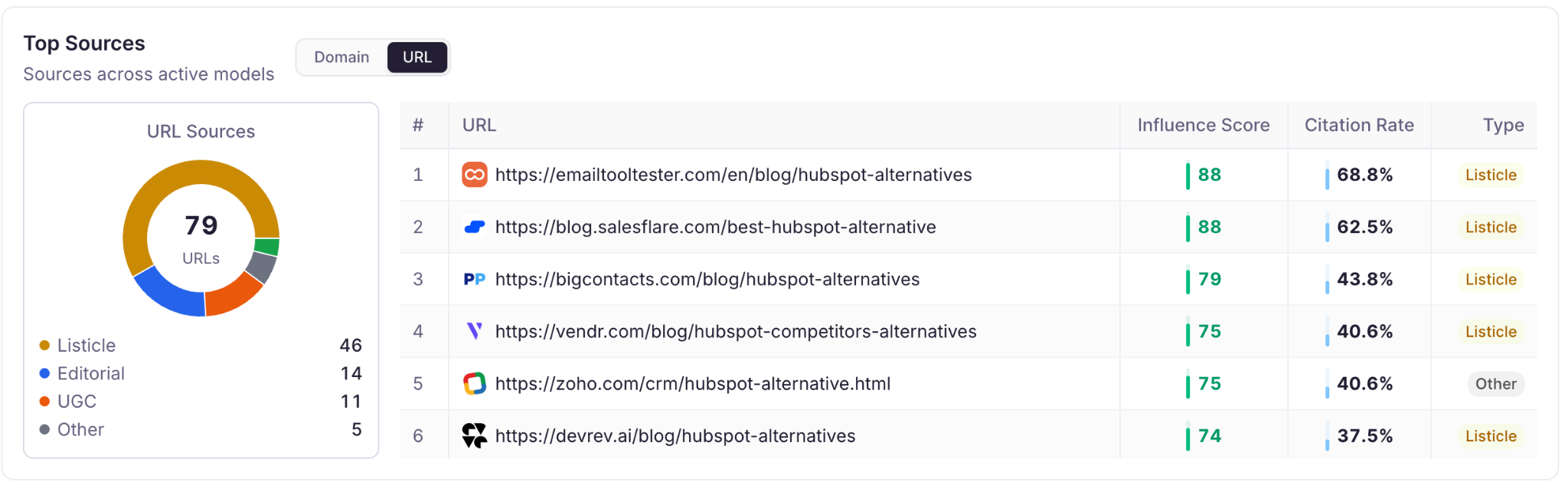
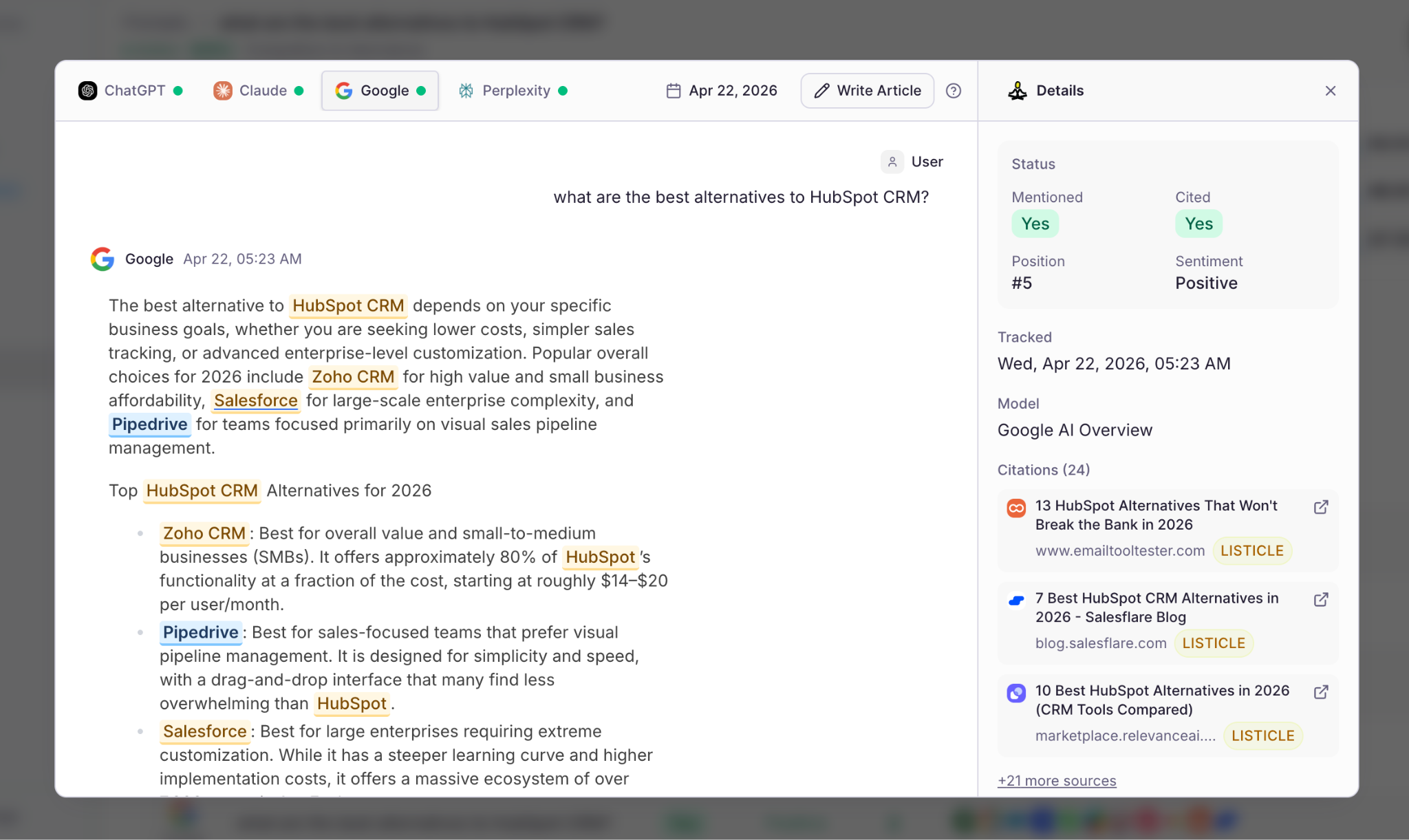
You can click on any prompt to see more data and insights for that prompt, such as for example:
- Your overall AI visibility, visibility in different models, and how your competitors rank:
- Top cited domains and URLs for that prompt (these are the sources that AI cites in its answers). The best way to quickly improve your AI visibility for these prompts is to get a mention on some of these URLs:
- Or the latest answers from different models for this specific prompt:
How to track your BOFU SEO rankings?
The process is similar as for the prompt tracking:
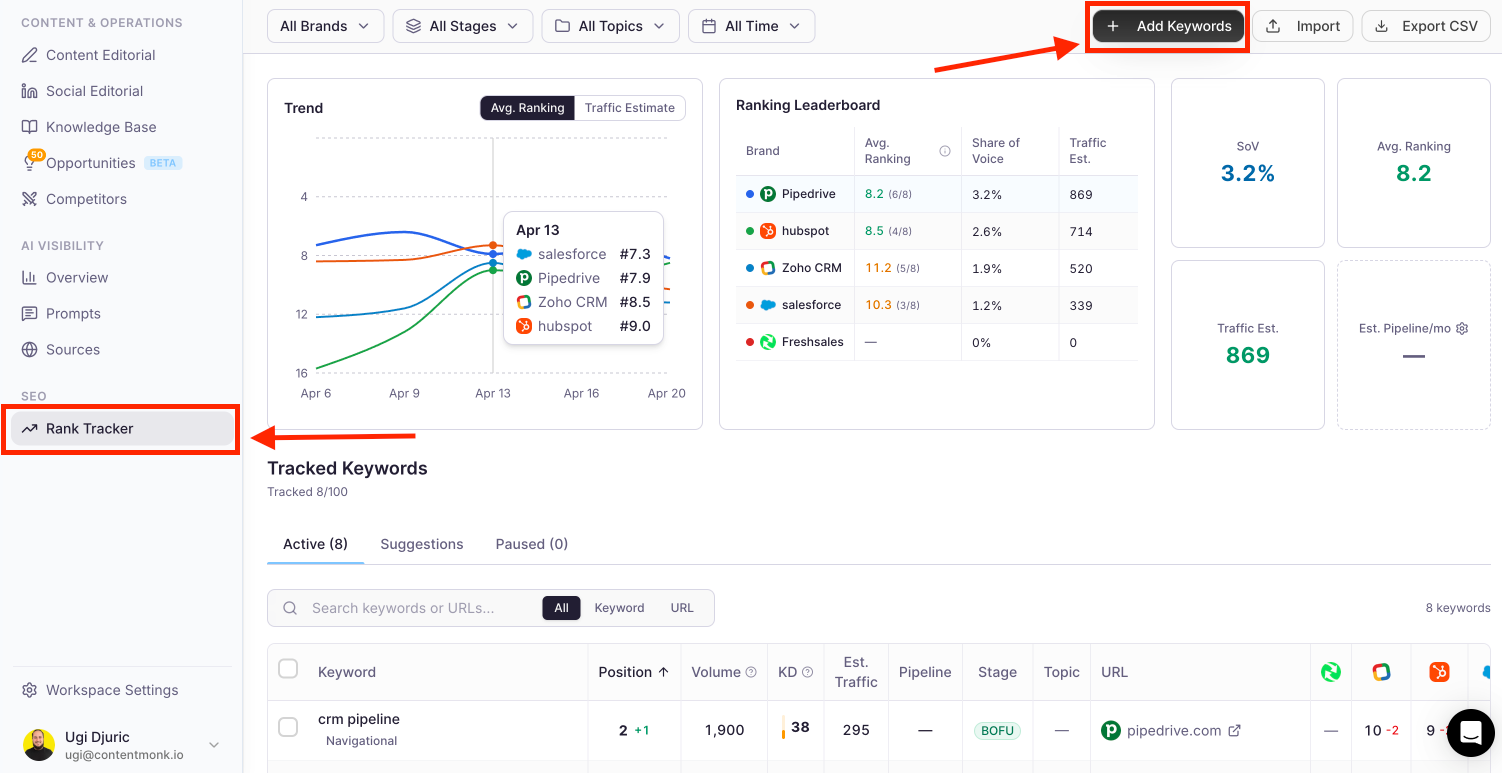
- Go to Rank Tracker in the left sidebar, and click on the “+ Add Keywords” in the top right corner:
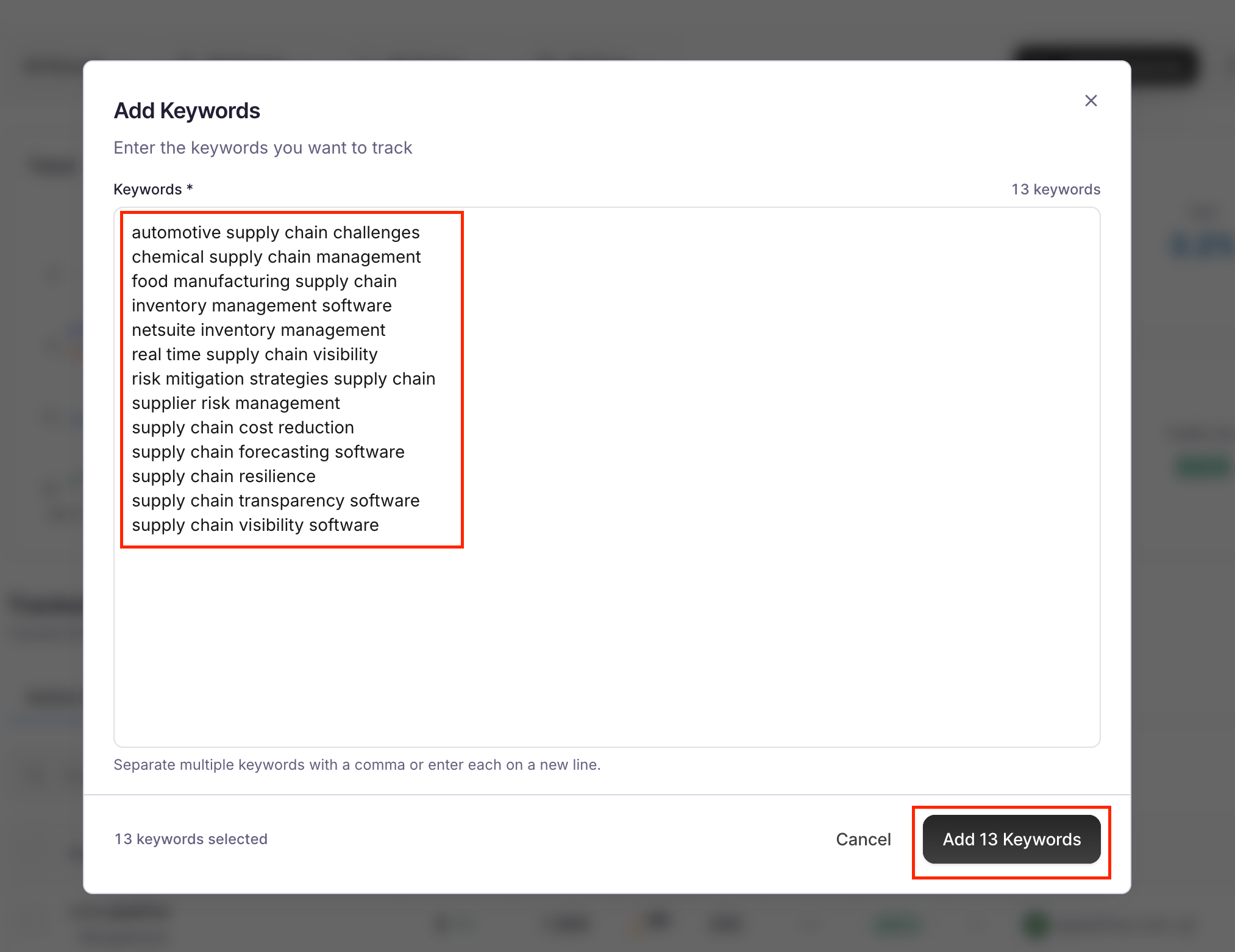
- Paste all of your focused keywords, one-by-line, and click on the “Add keywords” button
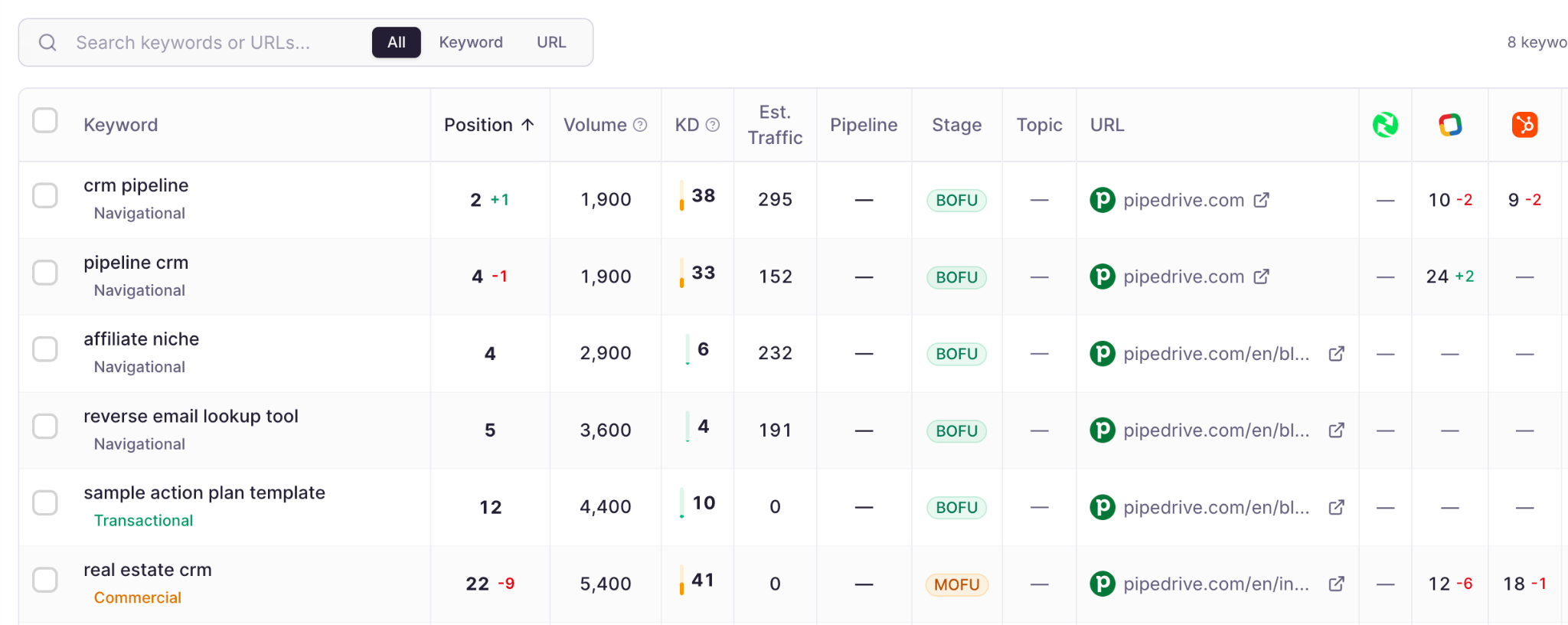
- Now, in a few minutes, you’ll be able to see your and competitors’ rankings for the focused keywords:
How to improve your AI visibility and SEO rankings?
Once you start tracking your prompts and keywords in ContentMonk, you can leave it to ContentMonk to suggest you real-time updates you can make to your content to start ranking better or getting cited by AI.
ContentMonk will:
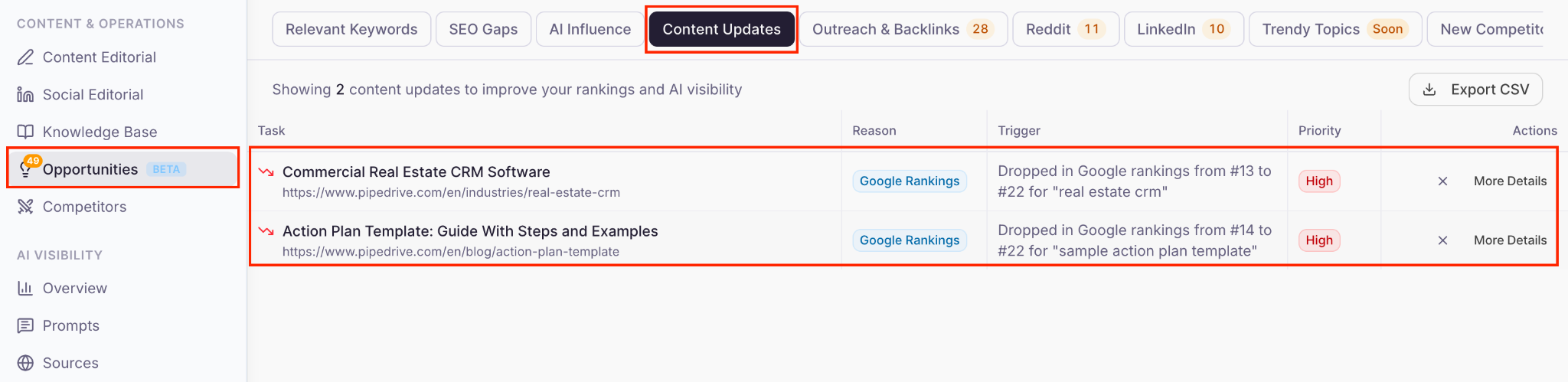
- Notify you whenever your articles drop in Google rankings or go stale at specific position for too long
- Other articles similar to yours are frequently cited by AI
You’ll see these notifications in the Opportunities pages:
Once this happens, you have option to let ContentMonk run research, analyze currently top Ranked articles, or top cited articles in AI, cross reference these articles with your content, and suggest the exact updates you can make inside your content to make it better.
You can then accept or decline ContentMonk’s updates in one click:
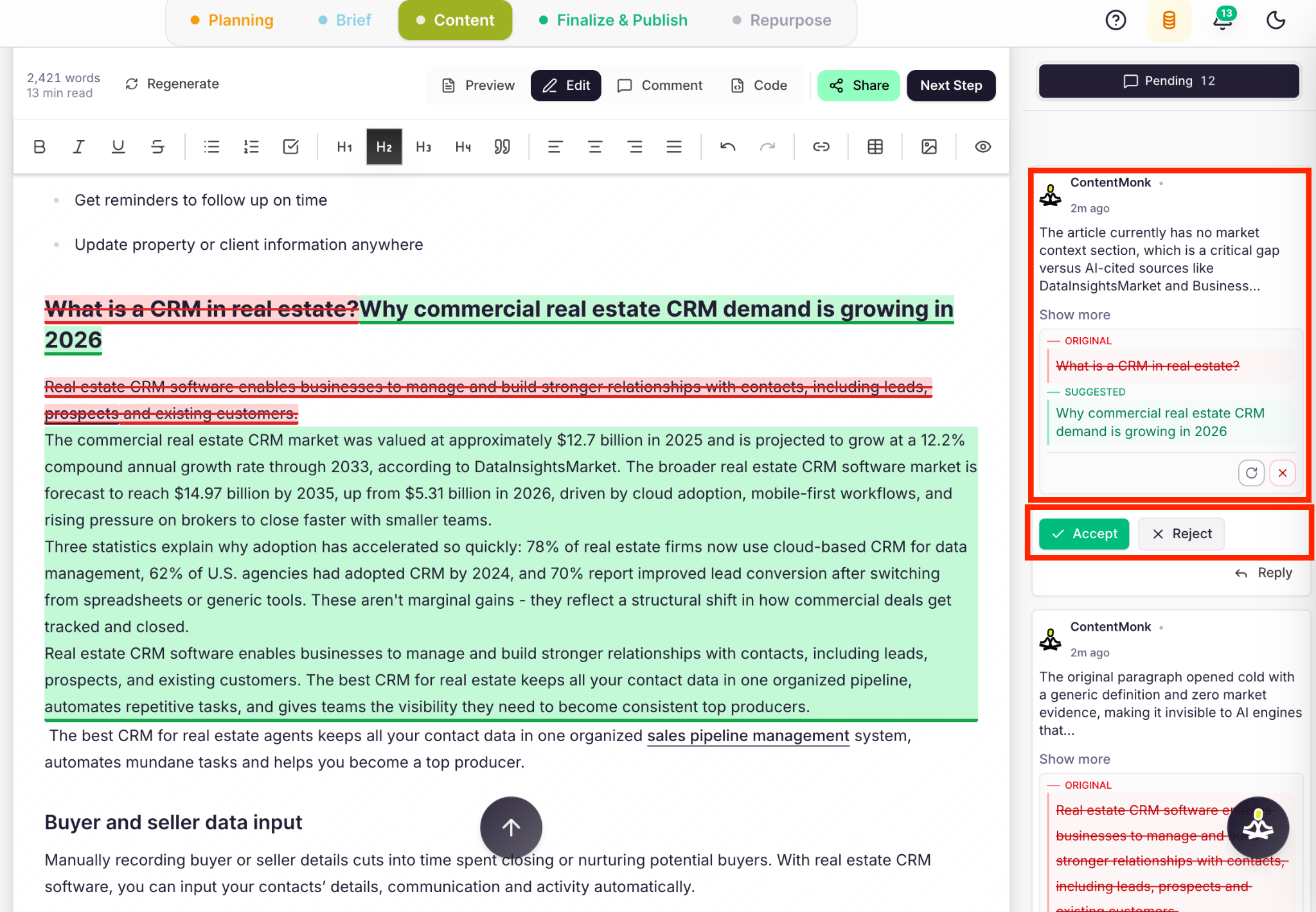
This allows you to keep your content up-to-date and optimized for AEO/SEO without almost any effort from your side.
The bottom line & how to get started
So, here’s a quick recap of what you need to do to dominate BOFU terms in your niche in both AI answers and Google rankings:
- Identify relevant BOFU terms
- Run Competitive research
- Upload all relevant documents to ContentMonk Knowledge Base
- Use one of the templates I shared above to create SEO/AEO optimized BOFU content
- Depending on the size of your niche and amount of competitors, expect to rank for your BOFU terms in 2-8 weeks (some backlinks in the meantime can definitely help).
- Start tracking your AI visibility and Google rankings inside ContentMonk
- ContentMonk will track your performance 24/7, and if there are no results after certain time, or your rankings drop, it will automatically suggest you the exact updates you need to create.
If you don’t have an ContentMonk account already, you can test this entire process during a 7-day free trial.
Good luck!
