
![HubSpot AEO Review - Is It Worth It? [+ 3 Better HubSpot AEO Alternatives]](https://cdn.prod.website-files.com/6710daeb9ee31a539dbb72d7/69e61f73472e4ace3ab9530f_HubSpot%20AEO%20Review%20and%20alternatives.webp)

The best HubSpot AEO alternative for most companies is ContentMonk, because it goes way beyond AI visibility tracking and is built to actively help you get customers from AI search (and from SEO as well), while HubSpot AEO is mostly there to give HubSpot users a low-cost view of how ChatGPT, Gemini and Perplexity talk about their brand.
That doesn't make HubSpot AEO a bad product. It has improved fast since its April 14, 2026 launch. The question is still the same: is HubSpot AEO good enough, or do you need something else?
I tested HubSpot AEO for several days after the April 14 launch, then ran the exact same brand and the exact same HubSpot-suggested prompts through three standalone AEO tools (ContentMonk, AirOps, and Profound) in the same environment.
This review is based on that side-by-side testing. I updated it in September 2026 with what each tool has shipped since, so the pros and cons describe the product as it is today.
So let's look at the HubSpot AEO review, its advantages and shortcomings, and how it compares to other AEO tools on the market.
Key Takeaways - HubSpot AEO Review and Side-by-Side Comparison
- CRM-powered prompt suggestions are HubSpot's real edge. No standalone AEO tool can draw prompt ideas from your own sales and customer records inside HubSpot's CRM. You can get close by feeding your customer research into an AI assistant such as Claude and tracking the prompts it suggests in any AEO software.
- It's cheap and easy to start. HubSpot AEO costs $50/month, or $45/month billed annually, with no Marketing Hub plan required, and it is included in Marketing Hub Professional and Enterprise. The 28-day free trial now covers 25 daily prompts across all three engines.
- It has grown up since launch. Sentiment, competitor share of voice, a redesigned Citations tab, recommendations with estimated citation lift, and one-click blog drafts all arrived after my first test. G2 users rate it 4.4/5 from 145 reviews.
- Coverage and depth are still the limits. It is still labelled beta, tracks 3 engines (no Google AI Overviews), caps you at 25 daily prompts (50 on Marketing Hub Enterprise), and has no keyword rank tracking or SEO data inside AEO.
- Best for HubSpot customers who want a first look. Activate the free trial, see where you stand, then decide whether you need a platform that also helps you act on the data.
- ContentMonk is the best alternative to get customers from AEO and SEO. It tracks 4 AI engines daily (ChatGPT, Gemini, Google AI Overviews and Perplexity), adds SEO rank tracking and keyword research, tells you what to fix, and helps you create content that ranks and converts, from $99/month. AirOps and Profound serve larger teams at higher price points.
If you want an AEO platform that tracks your AI visibility and your SEO in one place, tells you exactly how to improve both, and helps you turn that into traffic and customers, ContentMonk is the better fit.
Start the seven-day free trial and get your first AEO and SEO wins inside seven days.
HubSpot AEO Review - In-Depth Review from an AEO Expert
HubSpot announced HubSpot AEO at its Spring 2026 Spotlight event on April 14, built on its XFunnel acquisition. HubSpot agreed to buy XFunnel, a roughly 10-month-old Israeli AEO startup co-founded by Beeri Amiel and Neri Bluman, for $30 million in cash in October 2025 (HubSpot's announcement). As of September 2026, HubSpot's own catalog still labels HubSpot AEO as beta (HubSpot Product and Services Catalog).
At the surface level, the tool works like this: you add your brand, HubSpot suggests the prompts buyers are likely to use in AI assistants based on your CRM data, runs those prompts daily in ChatGPT, Gemini and Perplexity, and shows your visibility, sentiment and share of voice against competitors, plus the sources AI engines cite. Recommendations now suggest what to change, with an estimated citation lift, and can generate a blog draft in one click (HubSpot AEO product page).

HubSpot AEO is included in Marketing Hub Professional and Enterprise, or sold standalone at $50/month ($45/month billed annually), with no Marketing Hub plan required (HubSpot pricing). It comes with a 28-day free trial that now includes 25 daily prompts and 2,500 answers a month across all three engines (HubSpot Knowledge Base). That's far more than the trial I used at launch.
If you only want a quick snapshot, HubSpot's free AEO Grader is now called the AI Search Grader. It gives a one-time score out of 100 for how ChatGPT, Perplexity and Gemini describe your brand, with no account needed. G2 users rate the paid product 4.4/5 from 145 reviews (G2, September 2026).
HubSpot AEO Pros
- CRM-powered prompt suggestions are a real differentiator. Inside HubSpot, the AEO tool uses a customer's own CRM data to suggest prompts that real customers are likely to use in AI assistants. In my testing, the suggested prompts were relevant and well-targeted to our ICP. No standalone AEO tool has access to that data, and it beats guessing which prompts to track.
- Keep in mind that the gap is smaller than it looks. You can feed your own research (ICP research, jobs-to-be-done, sales call notes) into any AI assistant, such as Claude, and you'll get a solid prompt list you can track in any AI visibility software.

- The entry price is one of the lowest in the category. At $50/month standalone ($45/month billed annually), or included in Marketing Hub Professional ($800/month) and Enterprise ($3,600/month, both with one-time onboarding fees), HubSpot AEO is the lowest-friction way to get your first look at AI visibility data, especially if you already pay for Marketing Hub. Among good AEO tools, Otterly is one of the few that starts lower.
- A 28-day free trial with usable limits. The trial now includes 25 daily prompts and 2,500 answers a month across ChatGPT, Gemini and Perplexity. That's enough runway to see your baseline visibility, find which AI engines mention you, and decide whether you need more depth.
- It ships fast, and the future potential is real. In five months HubSpot added sentiment, competitor share of voice, a redesigned Citations tab with content type and brand-mention filters (Lupo Digital's August 2026 roundup), and recommendations with estimated citation lift. If HubSpot connects AEO data back to CRM attribution, showing which AI-referred leads turn into revenue, that would be hard for anyone else to copy. They have the sales data and the customer base.
HubSpot AEO Cons
Now this is where things get... interesting. When I tested HubSpot AEO in April, as someone who has played around with 50+ AI visibility tools, my verdict was that it was not yet ready to replace the more established AEO tools on the market.
HubSpot has fixed some of what I found since then, and I've removed or updated those points below. Several gaps remain.
The foundation for a good AEO product is there. What's still missing is more data depth, a connection between AEO and SEO data (the way ContentMonk does it), and a clear way to use HubSpot's sales data to prove AEO revenue.
Here are the issues that still stand as of September 2026:
- Tracks only 3 AI engines, and Google AI Overviews isn't one of them. HubSpot AEO monitors ChatGPT, Gemini, and Perplexity (HubSpot). It does not track Google AI Overviews, Google AI Mode, Claude or Microsoft Copilot. AI Overviews sit directly inside Google results, which makes them the most-seen AI surface for any brand that depends on organic search. G2 reviewers also ask for Claude support (G2).
- 25 prompts is a small sample. Drawing conclusions about your AI visibility from 25 prompts is like running a survey with 25 respondents. Marketing Hub Enterprise raises the cap to 50 (HubSpot Knowledge Base), and G2 reviewers name the prompt cap as their top complaint. Third-party reviewers report you can buy extra prompts (about $20/month per 10, per HubJoy), but HubSpot doesn't publish that price.
- Single location per brand (in my test). In my test I could only set one location per brand, so you couldn't split AI visibility by country. I haven't found documentation for multi-region tracking since, so check this during the trial.
- Citation data is better, but still shallow. At launch, you could only see citations one response at a time. HubSpot's August 2026 redesign added content type, brand-mentioned and URL search to the Citations tab. What it still doesn't list is a citation rate or influence score for each source, which is where the strategic data lives.

In other AEO tools, such as ContentMonk, you can filter source data by different criteria and see which URLs and domains are cited most often, how many times, and what their influence score and citation rate are. That makes it much easier to see which URLs are shaping the AI narrative, in which AI models, and how to reverse-engineer it.

- The dashboard felt thin at launch. In my April test, the interface was hard to navigate and the data stopped at AI Visibility score, Answers, Cited Domains, and Cited URLs. Sentiment and competitor share of voice have since filled part of that gap.
- Still in beta. Five months after launch, HubSpot's catalog still lists HubSpot AEO as beta (HubSpot). Expect features and limits to keep changing, which is a risk if you need stable reporting.
- No SEO data inside AEO. HubSpot AEO doesn't track keyword rankings or show search performance next to AI visibility. Without it, you only see half of the picture. Blog drafts from recommendations do exist now, though a third-party review reports each draft costs 1,000 HubSpot Credits and is limited to Marketing Hub Professional and Enterprise (HubJoy).
- Recommendations are new and still generic. In my April test, I imported a real domain and let it run for multiple days, and no recommendations surfaced. For comparison, the same domain with the same prompts in ContentMonk produced 20+ AEO recommendations and 100+ SEO improvement opportunities within 5 minutes of setup. HubSpot now generates recommendations with an estimated citation lift, but G2 reviewers describe them as "a little generic" (G2).

3 Best HubSpot AEO Alternatives with Better Data and Usability
HubSpot AEO has closed some gaps, but it is still a tracker with a narrow scope. If you need more engines, more prompts, SEO data, or help turning the data into customers, here are the best HubSpot AEO alternatives.
Every comparison below started with direct testing. I ran the same brand and the same prompts HubSpot suggested through ContentMonk, AirOps, and Profound in the same time window, and I've updated each tool's facts and pricing as of September 2026. Each tool serves a different buyer profile, and I'll be specific about who should choose what.
Let's see the best HubSpot AEO alternatives.
HubSpot AEO Alternative #1 - ContentMonk - Best HubSpot AEO Alternative to Get Customers from AEO and SEO
ContentMonk is the AEO and SEO platform for companies that want to get customers from AI search and Google. It tracks your AI visibility, your SEO performance and your website data in one place, and actively helps you get more traffic, get recommended inside AI answers, and turn that into customers. More than 300 customers use ContentMonk today.
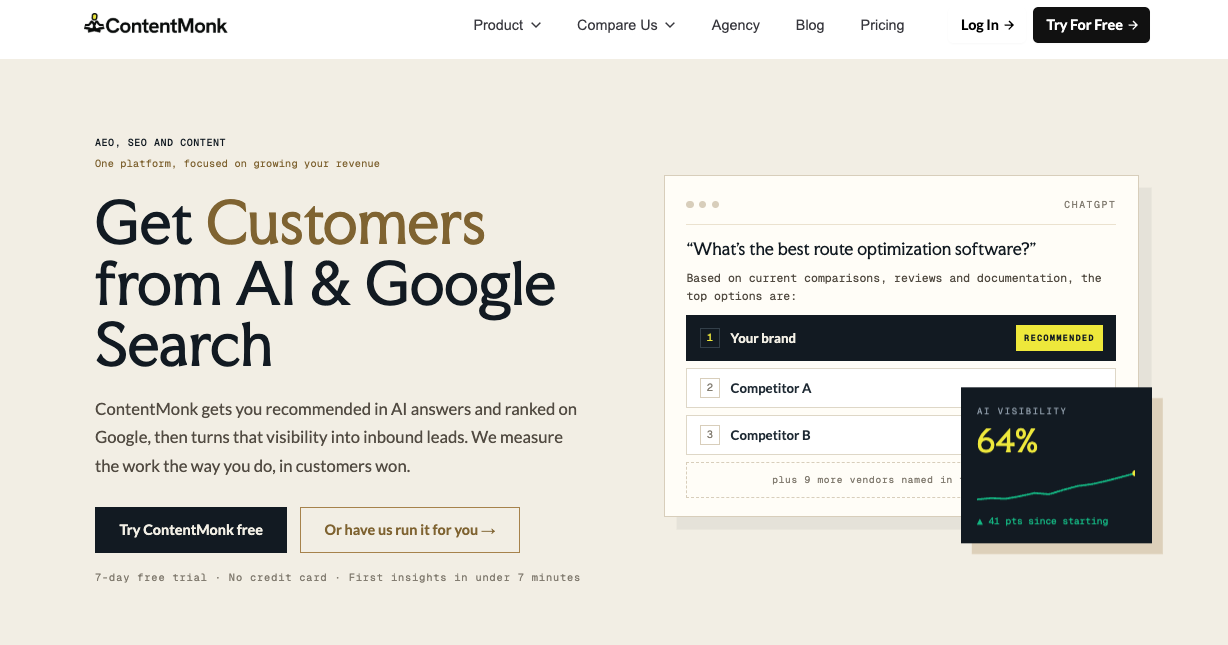
ContentMonk Overview and Key Advantages
Here is how ContentMonk helps you get customers:
- Tracks your AEO performance. Every day, ContentMonk tracks what ChatGPT, Gemini, Google AI Overviews and Perplexity answer your buyers for the prompts you choose. That's 4 engines versus HubSpot's 3, including Google AI Overviews, which HubSpot doesn't track. You see your and your competitors' visibility, sentiment, and the sources influencing AI answers, with Citation Rate, Influence Score, domain and URL type analysis, and multi-run citation data for every prompt.

- Tracks your entire SEO performance. Keyword rank tracking, keyword research, and in-depth Google Search Console and Google Analytics data give you one view of your SEO, website and traffic data. The Starter plan at $99/month includes 50 prompts tracked daily (double HubSpot's standalone cap), 200 tracked keywords, 50 keyword researches a month, and 5 competitors tracked alongside your brand.
- Proprietary AI tells you exactly how to win AEO and SEO. It analyzes all your AEO, SEO and website data and tells you exactly how to get more traffic, improve your AI visibility and keyword positions, and get more customers. Recommendations cover:
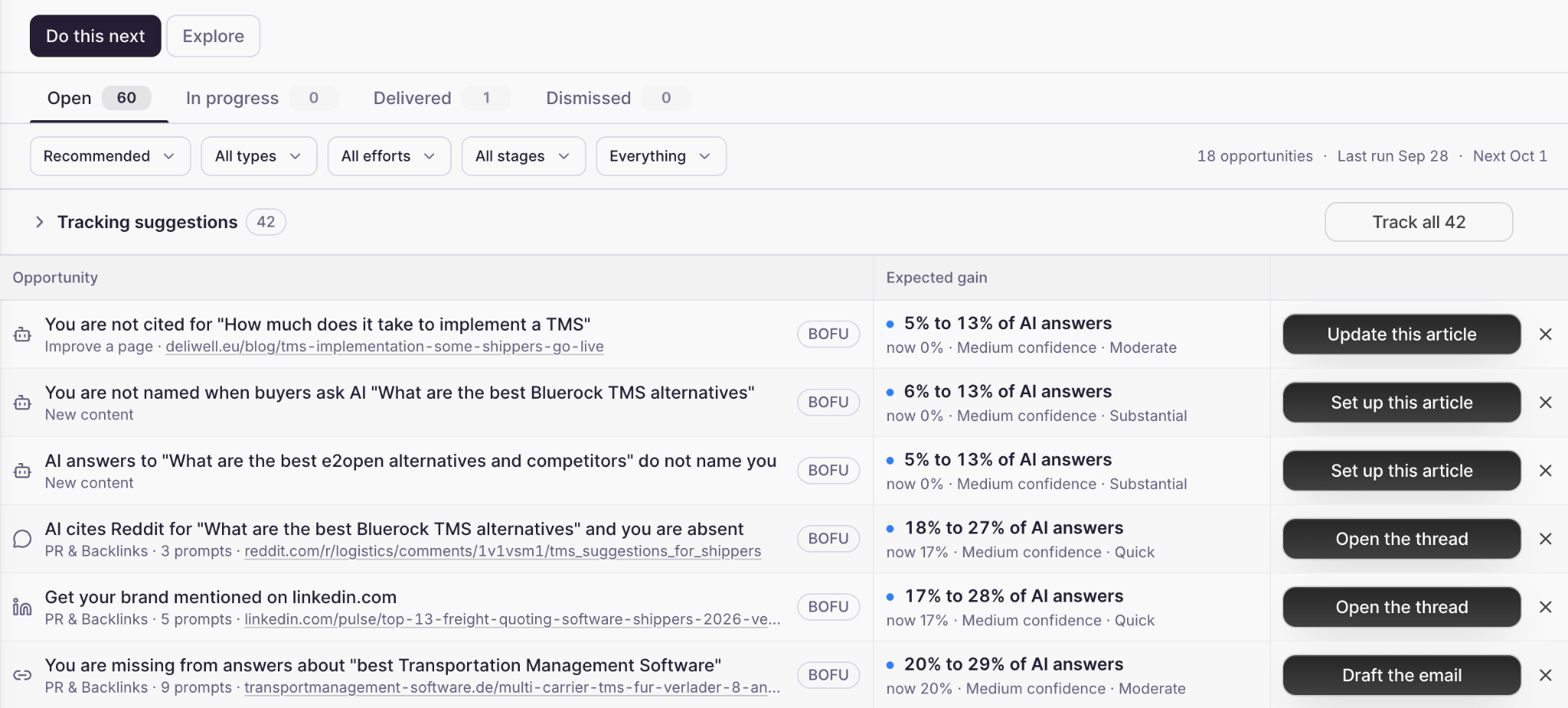
- AI visibility and citations: what to do to improve your AI visibility and get mentioned in AI engines
- Relevant keywords and SEO gaps: keywords where your competitors rank and you don't, filterable by funnel stage
- Content updates: changes that improve your AI visibility and rankings, triggered when a relevant published article isn't cited for prompts you track, when you drop in Google rankings, or when a page has been stuck on the same Google position for a long time

- Outreach and backlinks: key pages where a mention will have a big impact on your AI visibility and SEO rankings
- Reddit and LinkedIn opportunities: frequently cited Reddit and LinkedIn posts where a comment can improve your visibility
- Helps you create content that ranks and converts. When it's time to create or update content, ContentMonk's engine creates research-backed content in your voice and style (AI or your team writes), and repurposes it for LinkedIn and Reddit. It publishes to WordPress and Webflow.
- Proactive customer success team. Every customer gets a premium "concierge" service at no extra charge. ContentMonk's customer success team and AEO experts help you build a winning SEO and AEO strategy and execute it for the best results.
For example, if you want to write one article targeting an SEO gap, ContentMonk will:
- Research the best-ranking pages and the sources AI engines cite
- Find gaps from the SEO, AEO, and conversion perspective
- Consult your website and knowledge base for relevant insights
- Build a research-backed brief with SEO, AEO, and conversion best practices in mind
You can edit the brief to add more insights, and when you're ready, turn it into an article draft written in your voice and style (for context, ContentMonk wrote the first version of the article you're reading right now).

In my April side-by-side test, ContentMonk's first insights were available within minutes of adding a domain. Within 5 minutes, it surfaced 20+ AEO recommendations and 100+ SEO improvement opportunities.
Those recommendations turn into customers. Pest Pro Thermal, a heat-treatment pest control company, grew its AI visibility by around 20% and its inbound sales by around 32% in 90 days with ContentMonk.
Where ContentMonk falls short: it tracks four AI engines (ChatGPT, Gemini, Google AI Overviews and Perplexity), so teams that need Microsoft Copilot, Claude, Google AI Mode or Grok may be better served elsewhere. CMS publishing works only with WordPress and Webflow. And if your whole team lives inside HubSpot, ContentMonk won't pull prompt ideas from your CRM the way HubSpot AEO does.
ContentMonk vs HubSpot AEO - Side-by-Side Comparison
If you need a HubSpot AEO alternative with more engines, more prompts, SEO tracking, deeper source data, and a team that helps you turn it all into customers, ContentMonk is the right choice for you.
Start the seven-day free trial and get your first AEO and SEO wins inside seven days.
Pricing - ContentMonk vs HubSpot AEO
HubSpot AEO costs $50/month standalone ($45/month billed annually) for 25 daily prompts across 3 engines. Marketing Hub Enterprise raises that to 50 prompts, and HubSpot doesn't publish a price for extra prompts.
ContentMonk Starter is $99/month and includes 50 prompts tracked daily across 4 engines, 200 tracked keywords, 50 keyword researches a month, and 5 competitors. It costs more than HubSpot AEO, but you get double the prompts, Google AI Overviews, SEO rank tracking and keyword research, deeper source data, and help acting on all of it.

ContentMonk Pro at $199/month raises that to 150 daily prompts, 400 tracked keywords, unlimited workspaces, and unlimited competitors, and Scale at $449/month covers 300 daily prompts. Every feature is on every plan, and yearly billing saves 15%. All plans start with a seven-day free trial.
In a nutshell, ContentMonk's 7-day trial gives you more to act on than HubSpot's 28-day trial. More prompts, Google AI Overviews coverage, SEO data and recommendations mean you'll have a clearer picture of your AI visibility and organic search performance in one week.
Start the seven-day free trial and get your first AEO and SEO wins inside seven days.
HubSpot AEO Alternative #2 - AirOps - Best for Enterprise Teams Building Large-Scale Content Workflows
AirOps is a content engineering platform with AI visibility tracking built in. If you're a large team producing and refreshing content at scale inside automated workflows, AirOps is built for that job.
AirOps Overview and Key Advantages
The core strength is the no-code workflow builder: Grids for bulk content, plus Playbooks and Power Agents. Teams build repeatable production and refresh workflows once and run them across hundreds of URLs. AirOps raised a $40M Series B led by Greylock in November 2025 (AirOps) and holds a 4.7/5 rating from 134 reviews on G2.
Carta is one of its public customers, reporting a 7x increase in AI search citations (AirOps case study). The platform pulls SEO data from DataForSEO, Moz, Google Search Console, Google Analytics and its own keyword research, and publishes to CMS platforms including WordPress, Webflow, Contentful, Sanity and Ghost. Brand Kits and Knowledge Bases keep AI-generated content on voice.
AirOps Insights tracks share of voice, sentiment, and citations. The Pro plan covers "7+" answer engines, including ChatGPT, Claude, Gemini, Perplexity, Google AI Overviews and Google AI Mode, while the Solo plan tracks ChatGPT only (AirOps pricing).
AirOps also requires meaningful setup time. Workflows need to be configured before the platform delivers value, and one independent review puts the "click moment" at 3 to 4 weeks (Analyze AI). That makes it less suitable for small teams or fast evaluations.
AirOps vs HubSpot AEO - Side-by-Side Comparison
This table answers: what does AirOps offer that HubSpot AEO doesn't, and what does it sacrifice?
Pricing - AirOps vs HubSpot AEO
HubSpot AEO is $50/month ($45/month billed annually) for 25 daily prompts and 3 engines.
AirOps doesn't publish dollar prices. Every tier on its pricing page leads to a trial or a sales conversation, and the 14-day free trial needs no payment details. Third-party estimates put Solo at about $200/month and Pro at about $2,000/month (Analyze AI). Enterprise is custom.
The price gap is large because the use case is different. AirOps competes on content production and workflow depth at scale, while HubSpot AEO is a low-cost tracker. If you're a team of 2 to 5 marketers looking for AEO insights, AirOps is overkill. If you're a large content team that needs every step automated, the investment makes sense.
Best HubSpot AEO Alternative #3 - Profound - Best for Enterprise Brands That Need Maximum AI Visibility Data Depth
Profound had the most in-depth AI visibility data of any tool I tested: sentiment analysis, competitive share of voice, and prompt-level analysis. Since September 2026, brands can no longer buy a self-serve plan.
Profound Overview and Key Advantages
Profound raised a $180M Series D at a $1.8B valuation in September 2026, co-led by Sequoia and Kleiner Perkins, less than seven months after a $96M Series C (TechCrunch).
Profound's Enterprise plan tracks up to 9 answer engines, including ChatGPT, Perplexity, Gemini, Microsoft Copilot, DeepSeek, Claude and Google AI Overviews, and it captures answers from the browser front end rather than through APIs (Profound pricing). That's the widest engine coverage in this comparison.
The strongest features include sentiment and citation analysis, FactCheck for flagging inaccurate claims about your brand, and Prompt Volumes for estimating what your market asks AI assistants. In 2026 Profound also added AI Marketer agents that draft content and optimize pages, plus an Ads Studio.
Profound works with more than 1,000 enterprise brands, including 16% of the Fortune 500, such as Walmart, Comcast, U.S. Bank, Zoom, Ramp, and Figma. Enterprise includes SSO/SAML and SOC 2 compliance. G2 users rate it 4.5/5 from 1,130 reviews.
The catch with Profound is access. It removed its self-serve Starter ($99/month) and Growth ($399/month) plans for brands in mid-September 2026 (Trakkr). Brands now get a 7-day free trial (50 prompts daily on ChatGPT, Gemini, and Google AI Overviews), then a custom Enterprise quote. Compared with ContentMonk, which starts at $99/month with 4 engines and SEO tracking (Profound documents no rank tracker), that's a big jump for a small team.
G2 reviewers name price as the most common complaint and mention a learning curve and data overload for newcomers (G2). If you have the budget and the team to make use of the data, Profound delivers. If you don't, much of its value goes untapped.
Profound vs HubSpot AEO - Side-by-Side Comparison
This table answers: is Profound worth the price jump over HubSpot AEO, and for whom?
Pricing - Profound vs HubSpot AEO
HubSpot AEO: $50/month ($45/month billed annually) for 25 daily prompts across 3 engines, or 50 prompts on Marketing Hub Enterprise.
Profound: a 7-day free trial with 50 daily prompts on 3 engines, then custom Enterprise pricing for brands, with up to 9 engines, a custom prompt plan, and compliance features. Agencies have a separate Agency Growth plan that third parties report at $99/month base plus $399/month per client workspace (Trakkr).
Profound's pricing reflects its enterprise positioning. For most small and mid-sized teams, the cost of Profound's full feature set is hard to justify. ContentMonk gives you more engines than HubSpot AEO, SEO tracking, and help acting on the data from $99/month. For large brands with compliance requirements, dedicated analytics teams, and an enterprise budget, Profound has the deepest AI visibility data in this comparison.
The Bottom Line - HubSpot AEO Review Takeaways and Final Verdict
HubSpot AEO is a solid, low-cost starting point for teams already in the HubSpot ecosystem, and it has improved a lot since launch. As of September 2026, it is still in beta and still behind standalone AEO platforms on engine coverage, prompt volume, data depth, and SEO data.
Core shortcomings:
- Still labelled beta in HubSpot's own catalog
- Tracks only 3 AI engines, with no Google AI Overviews
- 25 daily prompts (50 on Marketing Hub Enterprise) is a small sample
- No keyword rank tracking or SEO data inside AEO
- No citation rate or influence score for cited sources
- One location per brand in my test, with no documented multi-region tracking
- Recommendations are new, and G2 reviewers call them generic
Real pros:
- CRM-powered prompt suggestions are the best in the category
- $50/month ($45/month billed annually) is one of the lowest entry prices, and it's included in Marketing Hub Professional and Enterprise
- 28-day free trial with 25 daily prompts on all 3 engines
- Sentiment, share of voice, recommendations, and one-click blog drafts added since launch
- Real future potential if HubSpot builds CRM-to-AEO attribution
Here's the final comparison across all four tools:
The practical recommendation: If you're already a HubSpot customer, use the 28-day trial for a low-friction first look at your AI visibility. It costs nothing to activate and you'll get a baseline reading.
If you want to get customers from AI search and Google, start ContentMonk's seven-day free trial. You'll track more prompts and engines, see SEO data next to AI visibility, and get recommendations to act on in the first week.
ContentMonk also has an agency side, so if you want an expert to handle your AEO strategy and get you customers from AI search, you can book a demo with ContentMonk's AEO experts.
Start the seven-day free trial
FAQ
What is HubSpot AEO and how does it work?
HubSpot AEO launched on April 14, 2026 at the Spring 2026 Spotlight event, built on HubSpot's acquisition of XFunnel, announced in October 2025. It tracks how your brand appears in AI-generated answers from ChatGPT, Gemini, and Perplexity, and uses your CRM and marketing data to suggest the prompts your customers are likely to use. It reports your visibility, sentiment, competitor share of voice, and cited sources, and suggests improvements. As of September 2026 it is still labelled beta.
How many AI engines does HubSpot AEO track?
HubSpot AEO tracks 3 engines: ChatGPT, Gemini, and Perplexity, with prompts run daily. It does not include Google AI Overviews, Google AI Mode, Claude, or Microsoft Copilot. Google AI Overviews are the most widely seen AI surface because they appear directly in Google search results, so missing them is the biggest gap for brands that depend on organic search. ContentMonk tracks 4 engines (ChatGPT, Gemini, Google AI Overviews, and Perplexity). Profound's Enterprise plan tracks up to 9.
Is HubSpot AEO worth it if I'm already a HubSpot customer?
If you're on Marketing Hub Professional or Enterprise, HubSpot AEO is included at no extra cost, so activate it and test it. The CRM-powered prompt suggestions and baseline data are worth having. As a standalone purchase, $50/month ($45/month billed annually) is cheap, but 3 engines, 25 prompts, and no SEO data make ContentMonk the stronger choice if your goal is to get customers from AI search. For $99/month you get 4 engines, 50 daily prompts, SEO rank tracking and keyword research, and recommendations to act on.
What is the best HubSpot AEO alternative for content teams?
ContentMonk is the best alternative for content teams that want AEO and SEO to bring in customers. It tracks AI visibility across 4 engines, tracks keyword rankings alongside Search Console and Analytics data, tells you what to fix, and helps you create research-backed content in your voice and repurpose it for LinkedIn and Reddit. Pricing starts at $99/month with a seven-day free trial, and every customer gets help from ContentMonk's customer success team at no extra charge. For content automation at large scale, AirOps is the stronger pick.
How does HubSpot AEO pricing compare to standalone AEO tools?
HubSpot AEO costs $50/month, or $45/month billed annually, for 25 daily prompts across 3 engines, and it's included in Marketing Hub Professional and Enterprise (50 prompts on Enterprise). ContentMonk costs $99/month for 50 daily prompts across 4 engines plus SEO rank tracking and keyword research, with public pricing on its website. Profound no longer sells self-serve plans to brands: after a 7-day trial, it's custom Enterprise pricing. AirOps doesn't publish prices; third-party estimates put its paid plans at about $200/month for Solo and $2,000+ for Pro.
