
The best GEO tool for most companies is ContentMonk because the product goes way beyond AI visibility tracking and is optimized to actively help you get customers from AI search (and SEO as well), while other GEO tools are mostly there to give you tracking & analytics. Profound is the GEO tool pick for enterprise brands, Peec AI is the cleanest pure GEO tracker, and Otterly is the GEO tool with the cheapest entry.
Below are the 10 GEO tools worth paying for, what each one is best at, and the results their own customers have published.
TL;DR - What's the best GEO tool for you?
- ContentMonk: best for companies that want to get customers from GEO and traditional SEO. It tracks your AI answers and Google rankings in one place, uses a proprietary AI to analyze all your data, and works with you to grow traffic, get recommended in AI answers, and get customers. Beyond the product, ContentMonk's customer success team and GEO experts actively help customers get results. Starts at $99/mo.
- Profound: best for enterprise brands that want the widest engine coverage (up to nine) and SOC 2 and HIPAA compliance. Custom enterprise pricing after a free trial.
- Peec AI: best for clean daily tracking with unlimited users on every plan. From $95/month.
- Semrush: best for teams already running their SEO in Semrush. AI Visibility Toolkit from $99/month (on top of the SEO software costs).
- AthenaHQ: best for ecommerce brands that want 11 AI models and Shopify data in one tool. Free plan, paid from $295/month.
- Scrunch: best for large GEO programs that need persona-level segmentation across seven engines. From $300/month.
- Writesonic: best for small teams that want GEO tracking next to keyword research and Search Console data. From $79/month billed annually.
- Otterly AI: best for the cheapest daily tracking, with Microsoft Copilot included. From $29/month, although the entry plan is very limited.
- SE Ranking (SE Visible): best for affordable five-engine tracking beside an SEO suite. SE Visible starts at $99/month.
- Ahrefs Brand Radar: best for competitive research on top of Ahrefs' backlink and keyword data. Ahrefs from $129/month, Brand Radar AI from $199/month.
What is a GEO tool?
A generative engine optimization (GEO) tool, also called an answer engine optimization (AEO) tool, shows whether AI assistants recommend your brand when buyers ask them for help. It runs your buyers' questions through different AI models (i.e. ChatGPT, Google AI Overviews, Gemini, etc.), records which brands and sources each answer names, and tracks how that changes over time.
The best GEO tools, such as ContentMonk or Profound, go two steps further. They tell you what to change so you start being recommended inside AI answers, and they show whether those changes brought in new customers.
How we chose the best GEO tools
We judged every tool on three things that decide whether a GEO tool pays for itself.
- It tracks AI answers by scraping the UI, instead of API calls. The Best GEO tools capture answers from the AI model's interface the way a real person gets them. Answers pulled through a model's API can differ from what users see, so a tool that relies on the API reports fake and misleading data. Unfortunately, many GEO tools track answers only through API calls.
- It does SEO in the same job. AI engines lean heavily on pages that already rank on Google, Bing, or other engines. A tool that shows your AI answers next to your rankings, Search Console, and Analytics data lets you fix both with one piece of work. The best AEO strategies are optimized for SEO at the same time, so your team doesn't have to do the double work.
- Its customers have published results. We think GEO is only worth paying for if it brings in customers. So for every tool, we looked at what its customers have published, and whether those results are leads and revenue or visibility alone.
The 10 Best GEO Tools Compared Side-by-Side
Here are the 10 best GEO tools compared side-by-side, based on the criteria above and their best use case.
What are the 10 Best GEO Tools for Tracking AI Visibility & Getting Customers From AI Search?
1. ContentMonk: best GEO tool for companies that want to get customers from GEO and AI Search
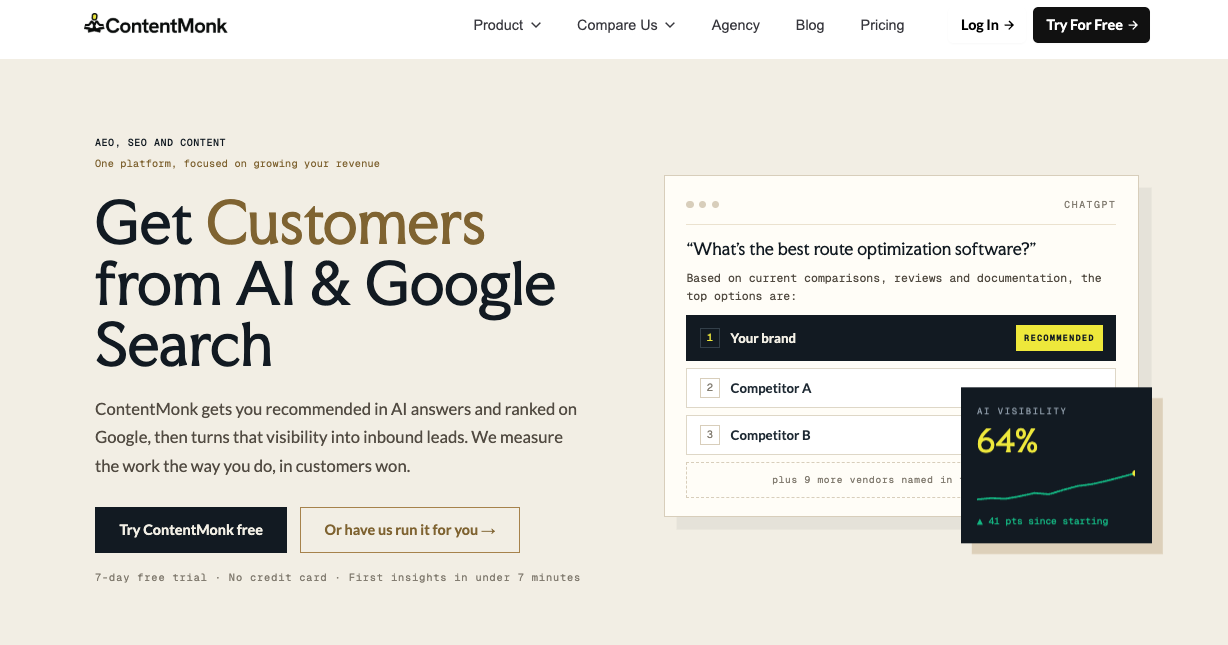
What it does. ContentMonk is the AEO and SEO platform that tracks your SEO performance, GEO data & AI visibility, and other website metrics, and actively helps you get more traffic, get recommended inside AI answers, and get more customers from Google & AI search.
How ContentMonk helps you get customers from GEO:
- ContentMonk tracks your GEO performance - ContentMonk tracks daily what ChatGPT, Gemini, Google AI Overviews, and Perplexity answer to your customers for the prompts you want. Then it reports back with detailed analytics on your & competitors' visibility, the sources influencing AI answers, and more.

- ContentMonk tracks your entire SEO performance - From keyword rank tracking to in-depth Google Search Console and Google Analytics data. ContentMonk sits on top of your entire SEO and website/traffic data, giving you a unified view of everything that's going on.
- ContentMonk's proprietary AI tells you exactly how to win at GEO and SEO - on top of all the GEO, SEO, and website performance data mentioned above, ContentMonk's proprietary AI analyzes everything and tells you exactly how to get more traffic, improve your GEO or keyword positions, and how to get more customers from Google & AI search.
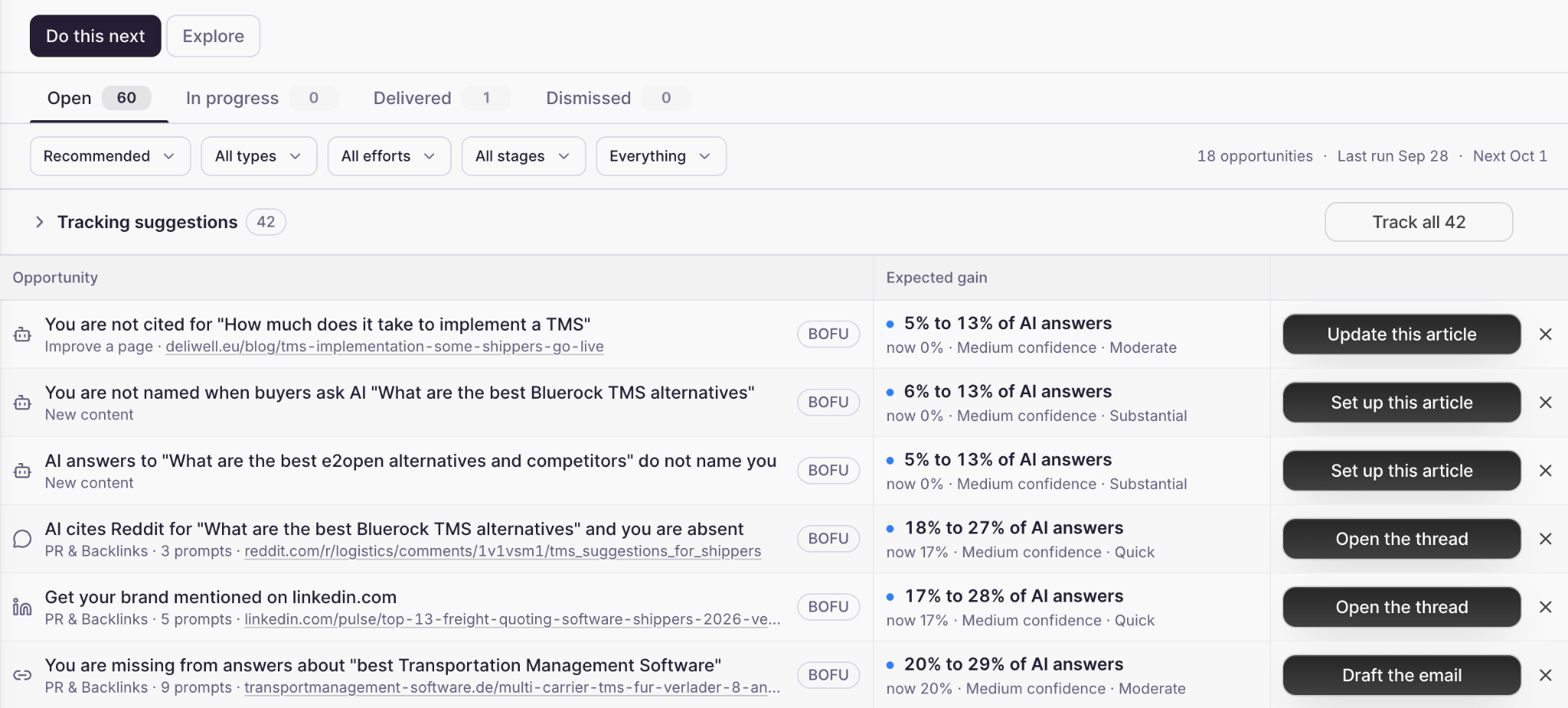
- ContentMonk helps you create content that ranks & converts - when it's time to create new content (or update existing), ContentMonk's engine helps you create the best possible and research-backed content, written in your voice & style.
- Proactive Customer Success team determined to help you get results - Every customer at ContentMonk gets a premium "concierge" service (at no extra charge), helping them create winning SEO and GEO strategies and execute for the best results.
Strengths: GEO and SEO live in one view, so one page can win the Google ranking and the AI citation together. Every feature is on every plan, and tiers only raise limits. ContentMonk has 300+ customers currently using It to get more customers from GEO.
Limits: ContentMonk tracks four AI engines (Gemini, ChatGPT, Google AI Overviews, and Perplexity), so if you want to track engines such as Microsoft Copilot, Claude, or Google AI Mode, other GEO tools might be a better fit. CMS integration currently works only with Webflow and WordPress, with no support for other website builders.
Customer results: Pest Pro Thermal, a heat-treatment pest control company, grew its AI visibility by around 20% and its inbound sales by around 32% in 90 days.
Pricing: Starter is $99/month with 50 prompts tracked daily. Pro is $199/month with 150, and Scale is $449/month with 300. There's a seven-day free trial, and no card is needed. See ContentMonk pricing and ContentMonk's AEO and GEO software.
Bonus: ContentMonk also has an Agency side of the business, so if you want an expert to handle your GEO strategy and get you customers from GEO, you can book a demo with ContentMonk's GEO experts.
2. Profound: best for enterprise brands that want the widest engine coverage
What it does. Profound tracks up to nine answer engines, including ChatGPT, Perplexity, Gemini, Google AI Overviews, AI Mode, Microsoft Copilot, Claude and DeepSeek. According to Profound's Answer Engine Insights page, it captures answers "directly from the browser" rather than through APIs. Its Agents turn findings into briefs and drafts and publish them to WordPress and other CMSs.
Strengths. Profound has the deepest analytics and the widest coverage on this list. It holds SOC 2 Type II and offers HIPAA to enterprise customers, which matters for healthcare and finance. It raised a $96 million Series C at a $1 billion valuation in February 2026, so it has the funding to keep building.
Limits. Profound pulls in Search Console data but has no Google rank tracker or keyword research of its own. Price is the most common complaint on G2, where it scores 4.5/5 from 1,130 reviews.
Customer results. Profound publishes about 21 case studies on its customers page. Alchemy reports a 7x higher signup rate from AI-referred visitors. Omnilux reports that AI-attributed revenue grew from about 1% to 3% of the total.
Pricing. A free seven-day trial tracks 50 prompts daily on ChatGPT, Gemini and Google AI Overviews. Paid plans are custom Enterprise packages, per Profound's pricing page. Our Profound review goes deeper into Profound's capabilities and limits.
3. Peec AI: best for clean daily tracking with unlimited users

What it does. Peec AI runs your prompts every 24 hours using browser automation on the AI platforms' own interfaces, per Peec's docs. It shows which sources each answer used and cited, ranks actions by impact, and measures what happened after you took each one.
Strengths. Every plan includes unlimited users, which suits teams where marketing, content and leadership all want access. The Impact view, which checks whether an action moved visibility, is one of the best-documented features of its kind on this list. Peec also offers an MCP server and a Looker Studio connector.
Limits. Each plan covers three models you choose, and Perplexity costs extra as an add-on. Peec has no rank tracking or keyword research, so SEO stays in another tool. One G2 reviewer wrote that they don't yet trust the recommendations to move the needle (G2, 4.7/5 from 21 reviews).
Customer results. Merge reports a 7x increase in demo requests from AI search and 6x higher conversion rates, per Peec's case study.
Pricing. Starter is $95/month for 50 prompts, Pro is $245/month for 150, and Advanced is $495/month for 350, with 15% off on annual billing (Peec pricing). We compare it head-to-head in Profound vs. Peec AI.
4. Semrush: best for teams already running their SEO in Semrush
What it does. Semrush adds GEO tracking to the SEO suite many marketing teams already pay for. Its AI answers are "captured from real requests and not via any APIs of LLMs", per the Semrush knowledge base, and it draws on a database of more than 317 million prompts. Adobe completed its $1.9 billion acquisition of Semrush on 28 April 2026 (Adobe).
Strengths. Position Tracking, keyword research, site audits and AI visibility sit in one subscription, and Semrush One starts at $199/month. For a team that lives in Semrush, adding GEO this way means no new vendor and no new logins.
Limits. Custom prompts run on ChatGPT Search, Google AI Mode and Gemini. Perplexity and AI Overviews data comes from Semrush's own prompt database and keyword tracking (Semrush KB). Creating content is a separate paid toolkit.
Customer results. Hertz Iceland reports 50% more bookings from AI sources in three months, though on Semrush's Enterprise AIO product (customer story). On the AI Visibility Toolkit, WorkLounge reports that its AI Overview visibility went from 17% to 34% (Semrush blog).
Pricing. The AI Visibility Toolkit is $99/month. Semrush One, which bundles SEO and AI visibility, starts at $199/month (Semrush pricing).
5. AthenaHQ: best for ecommerce brands that want 11 models in one tool
What it does. AthenaHQ tracks 11 AI models on its Starter plan and connects to Shopify, Google Analytics 4 and Search Console. It turns gaps into prioritized recommendations, then into briefs and drafts it can publish to eight CMSs, and it tracks citations for what you publish.
Strengths. AthenaHQ covers every step from spotting a gap to checking whether the new page got cited in one self-serve product. Product-level visibility makes it a strong fit for ecommerce, and it holds SOC 2 Type II.
Limits. Usage runs on credits, and "1 credit = 1 AI response", so a prompt tracked across many models uses credits quickly (AthenaHQ plans). Its docs don't say how answers are collected. Search Console is read-only, and there's no rank tracker.
Customer results. Popl reports 38.85% monthly growth in AI-driven leads within three months (AthenaHQ case study). AthenaHQ publishes about nine case studies in total.
Pricing. A free Essential plan comes with starter credits. Starter is $295/month with 3,600 credits. See also our AthenaHQ alternatives.
6. Scrunch: best for large GEO programs that need persona-level segmentation

What it does. Scrunch covers seven engines on every plan: ChatGPT, Claude, Gemini, Perplexity, AI Mode, Google AI Overviews and Meta. It segments results by persona, topic and buying stage. Its Agent Experience Platform serves AI-friendly versions of your pages to AI crawlers. Sitecore announced it had acquired Scrunch on 3 June 2026 (Sitecore).
Strengths. You get the broadest engine set with no add-on fees, plus persona-level filtering that suits big brands running several audiences. It holds SOC 2 Type II.
Limits. Scrunch collects answers with "a mix of browser automation and official platform APIs" (Scrunch FAQ). Each engine a prompt runs on counts as one prompt against your allowance. The product has no SEO, and one G2 reviewer found the improvement suggestions minimal (G2, 4.6/5 from 73 reviews).
Customer results. Runpod reports about 40 new customers a day from ChatGPT and 4x growth in new paying customers per month over 90 days (Scrunch case study). That is one of the clearest customer-acquisition results any vendor on this list has published.
Pricing. Starter is $300/month billed monthly, or $250/month billed annually (Scrunch pricing). We compare it in Profound vs Scrunch AI.
7. Writesonic: best for small teams that want GEO tracking next to keyword research
What it does. Writesonic tracks ChatGPT, Gemini and Google AI Overviews on its self-serve plans, and it scrapes "the actual web interfaces" of each platform (Writesonic docs). The same subscription includes keyword research, a Search Console connection, site audits and WordPress publishing.
Strengths. Writesonic has one of the lowest entry prices for daily tracking with SEO data in the same account, and a free trial that needs no card.
Limits. Perplexity, Claude and AI Mode are Enterprise-only (Writesonic pricing). There's no documented Google rank tracker. Most of its 2,135 G2 reviews date from its AI-writing years, so they say little about GEO.
Customer results. BlitzMetrics reports $200K in client revenue from AI search, including two clients worth more than $100K each (Writesonic case study).
Pricing. Starter is $79/month billed annually.
8. Otterly: best for the cheapest start
What it does. Otterly tracks ChatGPT, Google AI Overviews, Perplexity and Microsoft Copilot daily on every plan, with Gemini and AI Mode as paid add-ons. It adds a GEO audit and automated reports.
Strengths. At $29/month, Otterly is the cheapest daily tracker on this list. It includes Copilot, which several pricier tools skip, and every plan has unlimited users.
Limits. Otterly's docs describe querying engines "as a neutral, non-personalized user" but don't say whether that's through the interface or an API (Otterly help). It has no SEO features, and its SOC 2 claim covers the AWS data centers it runs on (Otterly security). The entry plan tracks 15 prompts.
Customer results. NOLA Marketing reports 30% more inbound leads for its client SPOC in 90 days, with citations growing from 665 to 3,617 (Otterly case study).
Pricing. Lite is $29/month, Standard is $189/month for 100 prompts, and Premium is $489/month for 400 (Otterly pricing). Read more about Otterly in our Otterly alternatives article.
9. SE Ranking (SE Visible): best for affordable tracking beside an SEO suite

What it does. SE Visible is SE Ranking's standalone GEO tracker. It collects "real AI responses using a browser" (SE Visible) on five engines: ChatGPT, Google AI Overviews, AI Mode, Gemini and Perplexity. The wider SE Ranking suite adds rank tracking, keyword research, Search Console and a content editor.
Strengths. SE Visible offers 200 prompts on five engines with unlimited users for $99/month, which is hard to match for pure tracking volume. Teams that want SEO alongside it can add the SE Ranking suite.
Limits. SE Visible itself doesn't give recommendations. The tracker and the SEO suite are separate products that count usage differently.
Customer results. We found no customer results tied to GEO. SE Ranking's customer stories focus on SEO (checked 25 September 2026).
Pricing. SE Visible starts at $99/month with a 10-day trial. The SE Ranking suite starts at $129/month (SE Ranking pricing).
10. Ahrefs Brand Radar: best for competitive research on top of Ahrefs' SEO data
What it does. Brand Radar maps how brands appear in AI answers across a large prompt database, and it runs your own custom prompts on ChatGPT, Perplexity, Gemini, Copilot, Google AI Overviews, AI Mode and Claude. Most prompts run through the engines' public web interfaces (Ahrefs methodology).
Strengths. It sits on the strongest backlink and keyword data on this list, and it can show share of voice for any brand with no setup. That makes it a strong research tool for sizing up competitors before you commit budget.
Limits. The database indexes refresh monthly, so fast changes show up late. Brand Radar is an add-on to a paid Ahrefs plan, and it doesn't draft or publish content.
Customer results. We found none with figures (checked 25 September 2026).
Pricing. Ahrefs starts at $129/month and Brand Radar AI starts at $199/month (Ahrefs pricing).
How to choose the right GEO tool
Start from the result you need, then check that the tool reads real answers and connects to your SEO data.
- You want to get more customers from GEO and SEO: ContentMonk, because the entire GEO platform is built to get you more customers. On top of that, ContentMonk's customer success team actively helps you get the results you seek.
- You're an enterprise brand with compliance needs: Profound, or Scrunch if persona-level segmentation matters more.
- You already have a content team and want tracking only: Peec AI, SE Visible or Otterly.AI.
- You already pay for Semrush or Ahrefs: try their add-on first, and check which engines it covers for custom prompts.
- You run an ecommerce store: AthenaHQ, for product-level tracking and Shopify data.
Want the shortcut? ContentMonk shows the buyer questions where you're missing, what each gap is worth, and the fix to make first. Start the seven-day free trial, no card needed.
Do you need a GEO tool if you already use Semrush or Ahrefs? Only if their GEO add-on misses engines your buyers use, or if you want the tool to actively help you get better results. Both suites have solid AI visibility data. Most teams struggle to turn that data into the action that delivers results.
How to get customers with a GEO tool
A GEO tool brings in customers when you use it for four moves, no matter which tool you pick.
- Track the questions buyers ask right before they pick a vendor. Skip vanity prompts about your own brand name, and track the "best X for Y" and "X in [city]" questions where a shortlist gets made.
- Improve the pages AI already cites, or publish a better one. The engines quote a small set of pages for each question. Find them, see what they cover, and make your page the clearer answer.
- Get mentioned where the engines look. Many of the pages AI answers cite are third-party reviews, lists, and threads, so a mention on one of them can matter as much as your own site.
- Measure leads. Visibility is the leading indicator. Inbound leads and sales are the results that show the tool is working.
Pest Pro Thermal shows the first and last moves in practice. The team tracked metro-area versions of its buyers' questions across ten major US cities, the questions people ask when they need pest heat treatment in their city. Within 90 days its AI visibility was up around 20% and inbound sales around 32%.
Think of it like shelf placement in a supermarket. Being on the AI shortlist works like eye-level shelf space, and the store's buyers and distributors decide it as much as the brand does. For GEO, the equivalents are the pages and communities AI engines already trust.
What GEO tools can't do
AI answers change from one run to the next, so a GEO tool reports a trend across many runs, and a single answer tells you little on its own.
No tool can make an engine cite you. The tool shows where you're missing and what to change, and your team (or an agency) still does the work. The customer results above took between one and six months to show up, so budget for a quarter before you judge a tool. Whether AI crawlers can reach your site at all is a separate question that tracking doesn't answer, so check whether AI crawlers can access your website first.
The Bottom line
- Pick the tool that gets you customers. For most companies, that means AI answers and Google rankings in one place, with the fixes ranked by revenue. ContentMonk is built for exactly that.
- Buy a tracker if you already have the team. Peec AI, SE Visible and Otterly.AI give you clean data at a lower price, and your team does the rest.
- Check the proof before you pay. Ask any vendor for customer results in leads or revenue, and read their case studies.
- Start the ContentMonk free trial and get your first GEO and SEO wins inside seven days. We don't stop at visibility: every recommendation is aimed at the leads and customers AI search can send you. Start free.
- Prefer to hand it off? Our agency team takes over and owns the inbound leads that come from AI and SEO. Get your GEO and SEO strategy.
FAQ
What is the difference between GEO tools and AEO tools?
They're the same category under two names. Generative engine optimization (GEO) and answer engine optimization (AEO) both describe getting your brand named and cited in AI answers from ChatGPT, Perplexity, Google AI Overviews and Gemini. Vendors use whichever label their buyers search for.
Are there free GEO tools?
A few. Profound offers a free seven-day trial with 50 prompts tracked daily, and AthenaHQ has a free plan with starter credits. ContentMonk offers a free AEO and SEO audit. For ongoing daily tracking, Otterly.AI is the cheapest paid option at $29/month.
Do I need a GEO tool if I already use Semrush or Ahrefs?
Not always. Semrush and Ahrefs both track AI visibility, but each covers a different set of engines for custom prompts, and neither ranks what to fix first by revenue. If you want those priorities, add a dedicated GEO tool or use one that combines GEO and SEO.
How much do GEO tools cost?
Entry plans run from $29/month (Otterly.AI) to about $300/month (Scrunch). ContentMonk, Peec AI, Semrush's AI Visibility Toolkit and SE Visible all start between $95 and $99/month. Enterprise tools such as Profound sell custom packages after a trial. Prices change often, so confirm on each vendor's pricing page.
How long does GEO take to bring customers?
Most published results appear within one to six months. SPOC's 30% lead growth took 90 days, Runpod's customer growth came over 90 days, and Popl's lead growth came within three months. Expect a quarter of steady work before you judge the results.